Hey, everybody. Welcome to Retell Seller, an ephemera podcast where I uncover forgotten stories and the ephemera people leave behind. I’m Angie, a reseller of 10 years, and I’ll share one of those snippets with you. Let’s see what today’s find has to say
Please know some links in this post are affiliate links. If you click on a link and make a purchase, I may receive a small commission with no extra cost to you. Thank you. Click here for my full disclosure.
I have quite a few postcards to share so I’ve divided them into two episodes. I won a small lot of 17 unused, gorgeous wildlife and nature postcards at a local online auction. They were created by the National Wildlife Federation out of Washington, D.C.
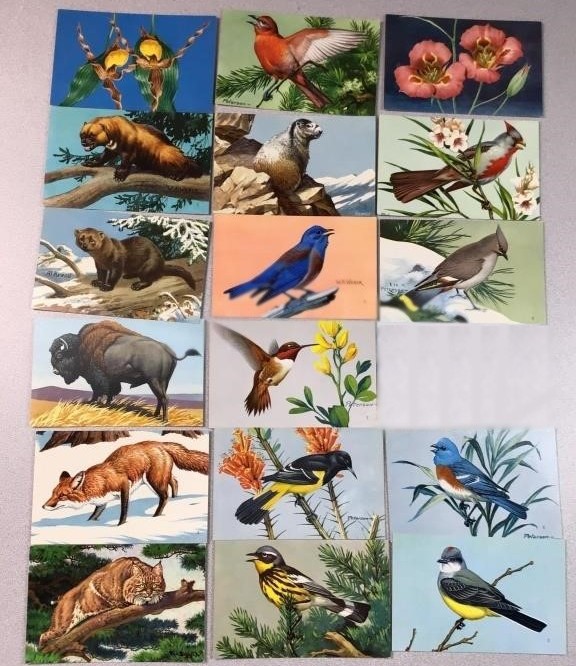
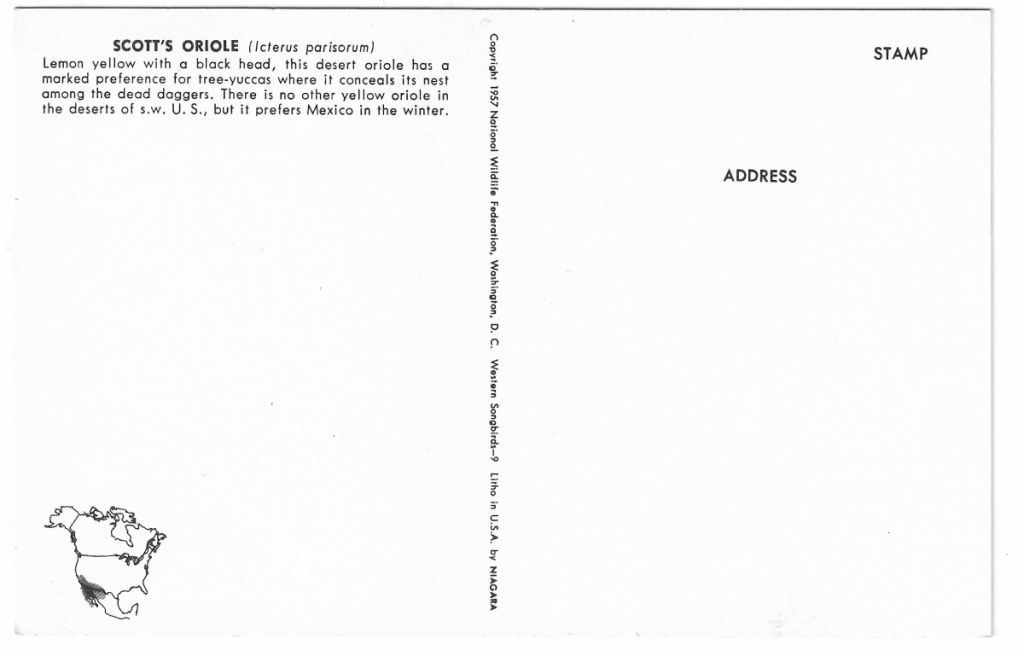
All are unused. Down the center of the back of each card is a date, a category the image falls into, Litho in USA by Niagara.
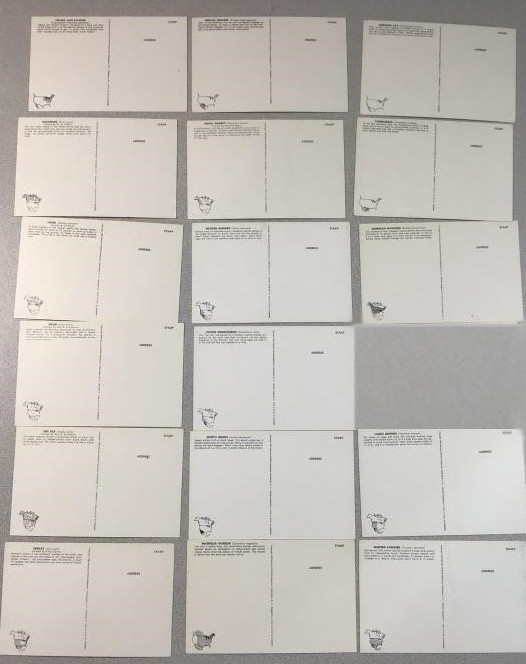
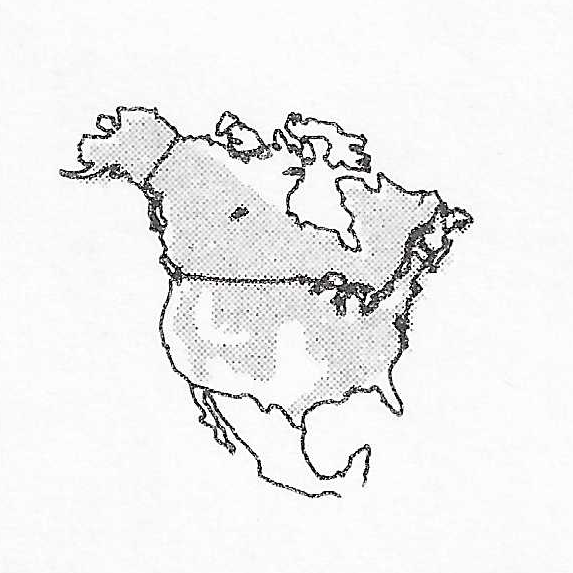
There’s a small drawing of the United States in the lower left corner with shaded areas letting you know which locations where the animals or flowers were known to exist at the time
Each card states the name of the animal or flower along with the scientific names and a short description. I will try to pronounce the scientific names, but we’ll see how that goes. So the first postcard is of the Magnolia Warbler, Dendroica magnolia, marked as, Songbird-6, dated 1957, described as
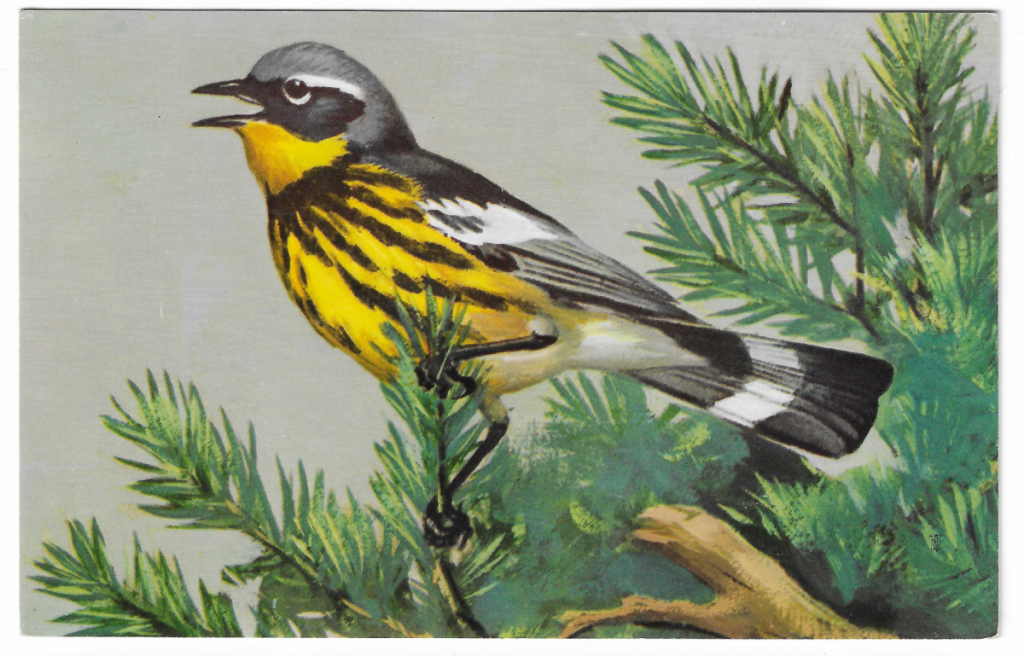
“Just over five inches long, this remarkably nervous and active warbler gleans an abundance of cankerworms and similar insects, mostly from the leaves of woody plants. The female is duller than the male, but equally active”

The map on the card shows it’s practically everywhere but the westernmost United States. And here’s a clip of how the Magnolia Warbler sounds:
Sharing wildlife sounds from around the world
My card is not signed, However, I found a stamp someone was selling from 1958 of this same image, and it was signed Peterson.
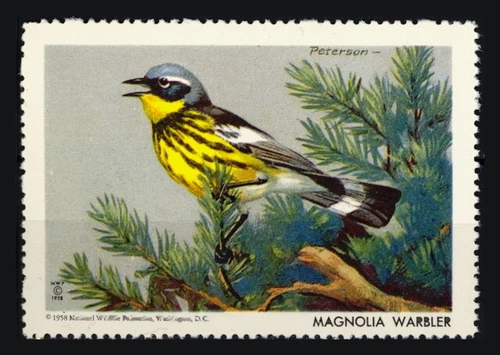
I’ve never made a purchase from this store.
I knew I had some other cards with that name, I found I had seven total of Roger Tory Peterson being the artist. Roger served as art director of the National Wildlife Federation’s Conservation Stamp Program. The ABA, or American Birding Association, named an award after him, and he was once nominated for the Nobel Peace Prize
He also painted Scott’s oriole, Icterus parusorum, listed as Western Songbirds-9, dated 1957.
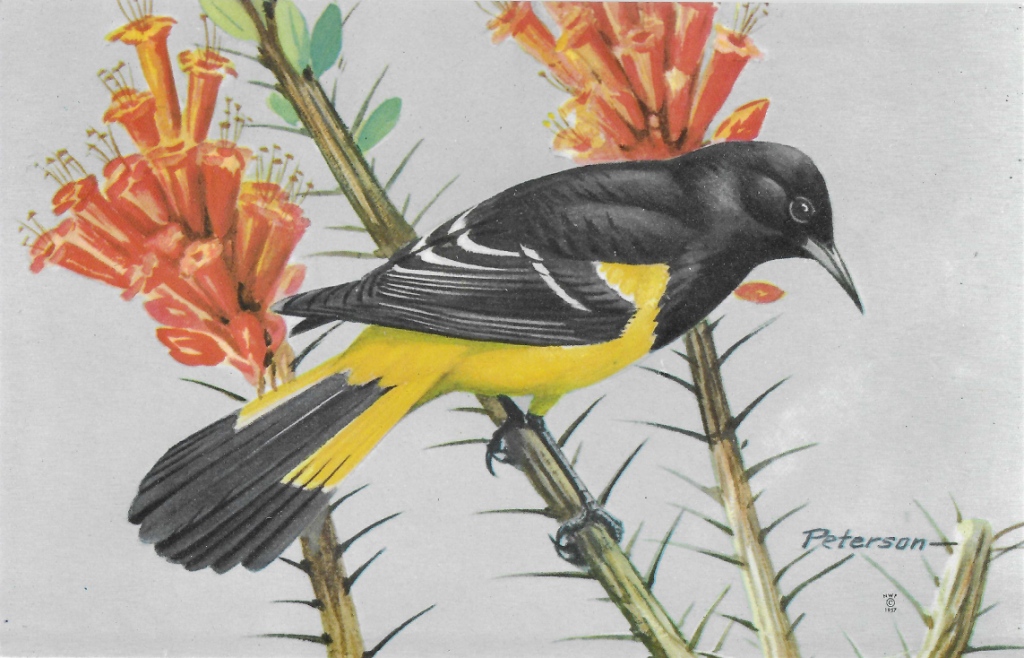
Described as “Lemon yellow with a black head, this desert oriole has a marked preference for tree yuccas where it conceals its nest among the dead daggers. There is no other oriole in the deserts of Southwest US, but it prefers Mexico in the winter.”
Scott’s Oriole was named after Winfield Scott, a US general who was responsible for the forced removal of Native Americans from their homelands, known as the Trail of Tears. Because of this, there have been proposals to rename the oriole the Yucca Oriole. Since that is where it nests.
We have the Hepatic Tanager, Piranga flava hepatica, Songbird-1, dated 1957.
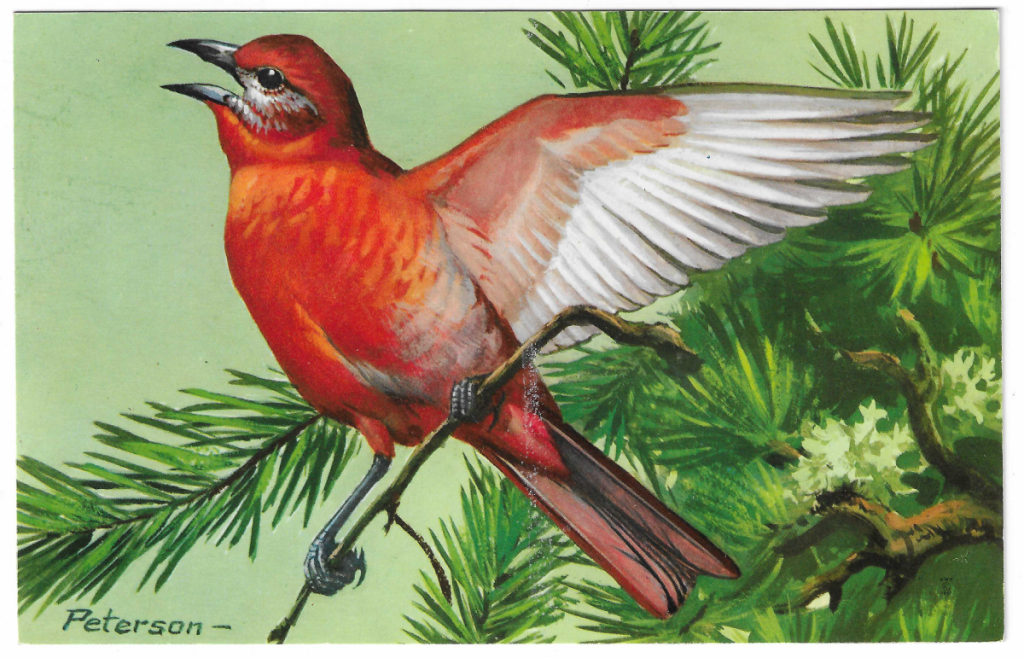
This card reads, “Only in the Southwest can we see the hepatic tanager in the United States. Its song is clearer than that of the well-known scarlet tanager. It is 7 1/3 inches long. Females are dull olive green above and yellow olive below.”
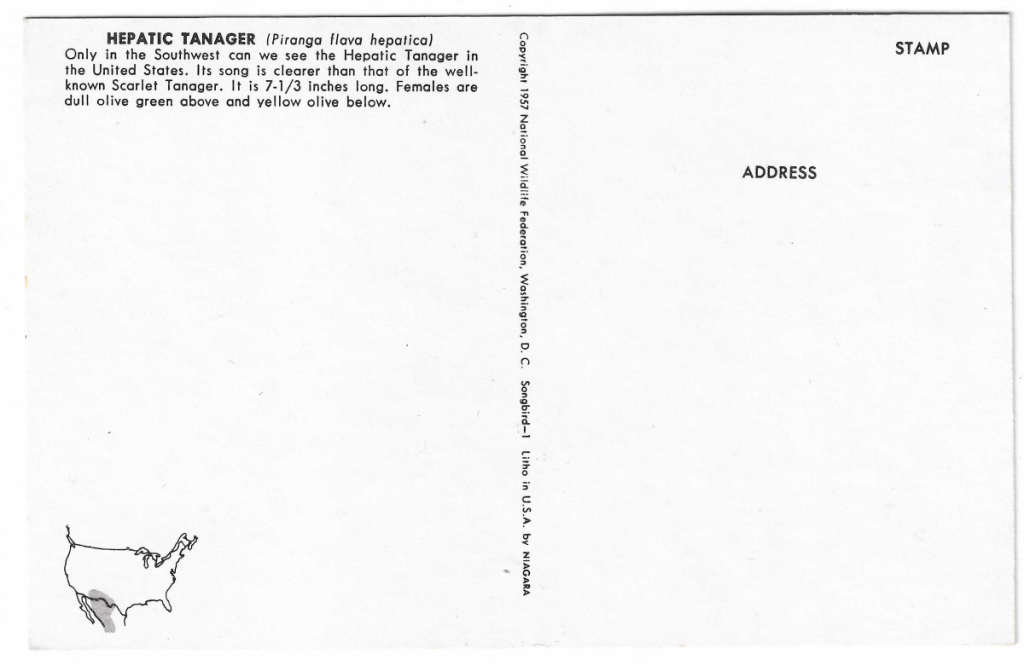
When I looked this up, I found while it was previously listed as being part of the tanager family, It’s now known to be part of the cardinal family
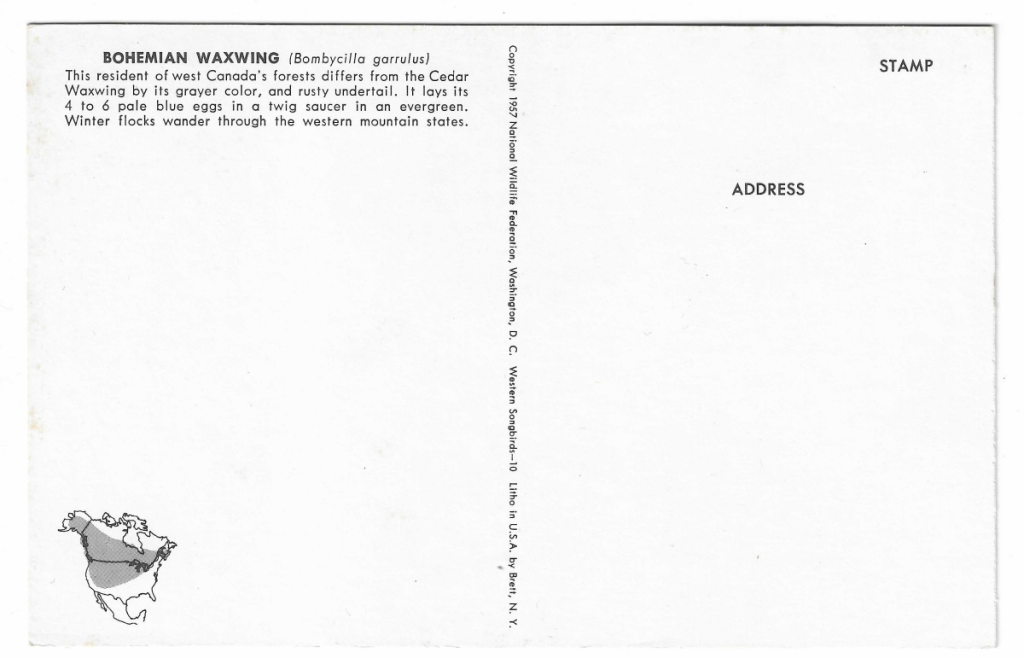
Now we’ve got the Bohemian Waxwing, Bombacilla garrulus, Western songbird-10, 1957.
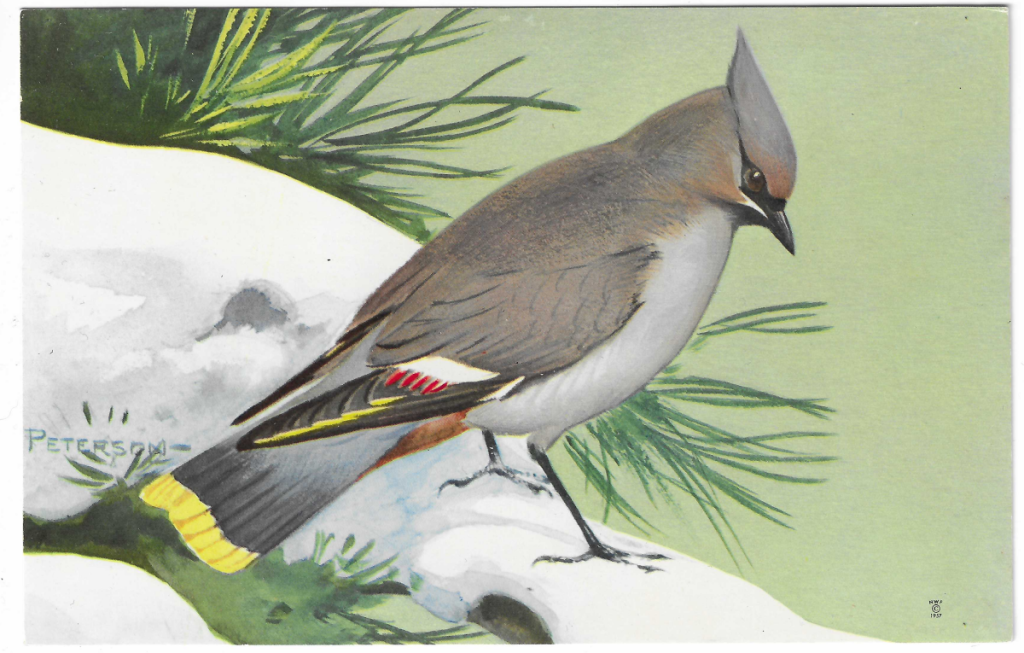
The card says, “This resident of West Canada’s forests differ from the cedar waxwing by its grayer color and rusty undertail.” It lays its four to six pale blue eggs in a twig saucer in an evergreen. Winter flocks wander through the western mountain states.”
Apparently, many people thought epidemics like cholera and the plague were brought on by the waxwings since their migrations seemed to coincide with the outbreaks.
Those who believed this to be true, out of caution, would eat juniper berries just as the waxwings did, and would burn the branches in their homes to ward off any disease.
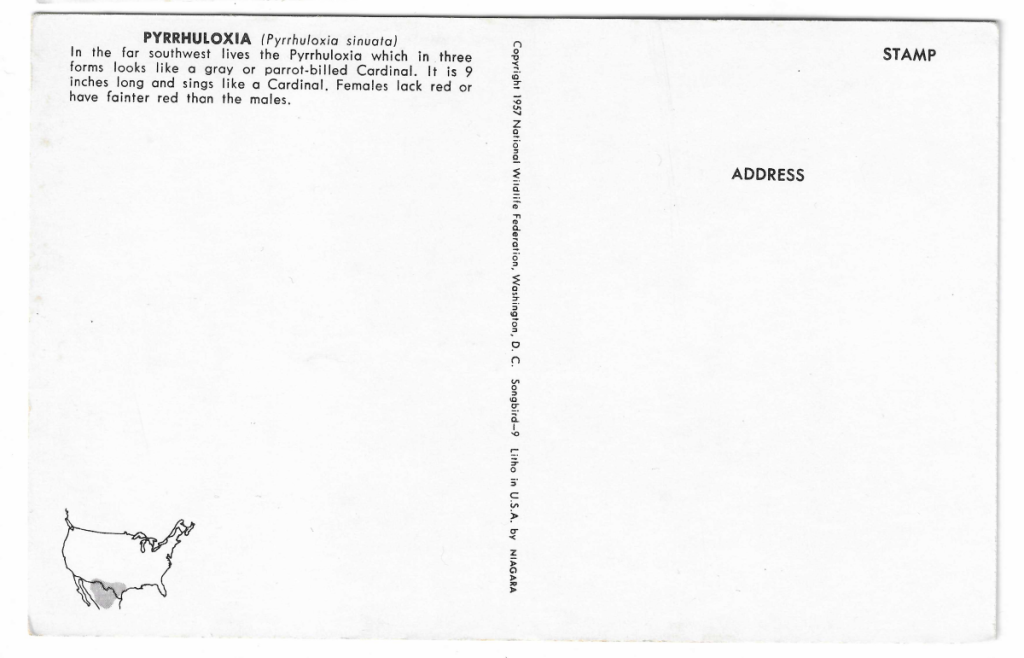
Next is the Pyrrahuloxia sinuata. Songbird-9, 1957.
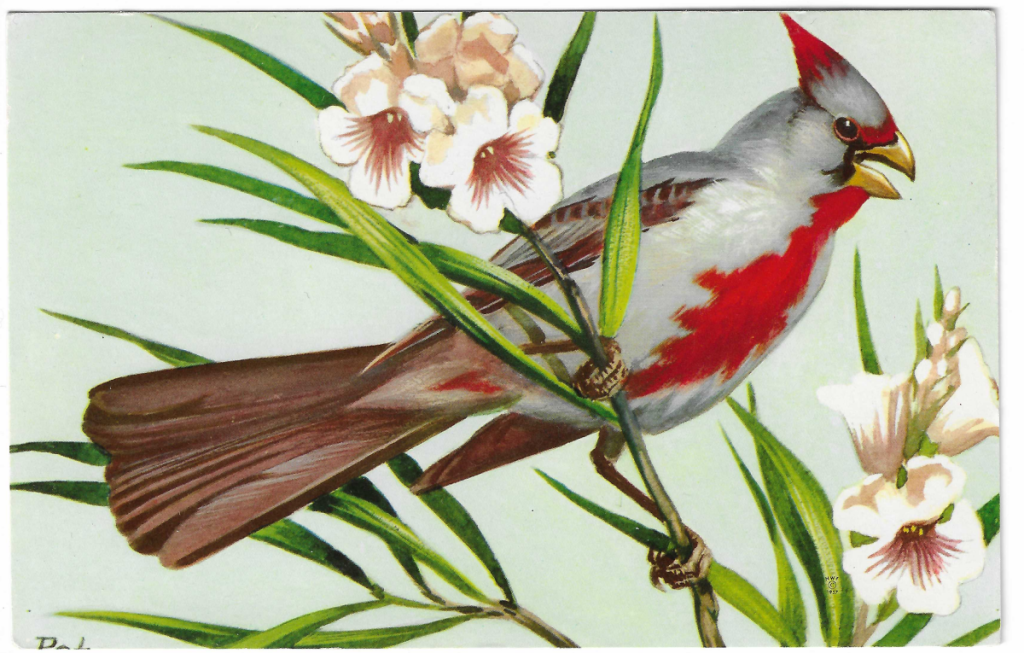
This says, “In the far southwest lives the Pyrrahuloxia, which in three forms looks like a gray or parrot-billed cardinal. It is nine inches long and sings like a cardinal. Females lack red or have fainter red than the males.” This bird is also known as a desert cardinal.
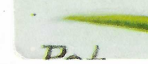
And a little aside, While this was a Peterson painting, as I was looking at my scanned image, I see it looks like I cut off the name, so I went to rescan it, and I realized, nope, that’s just how the postcard looks. You can only see the top of the first few letters of his last name, so.
Next is the Rufous Hummingbird, Selasphorus rufus, Western Songbird -8, 1957.
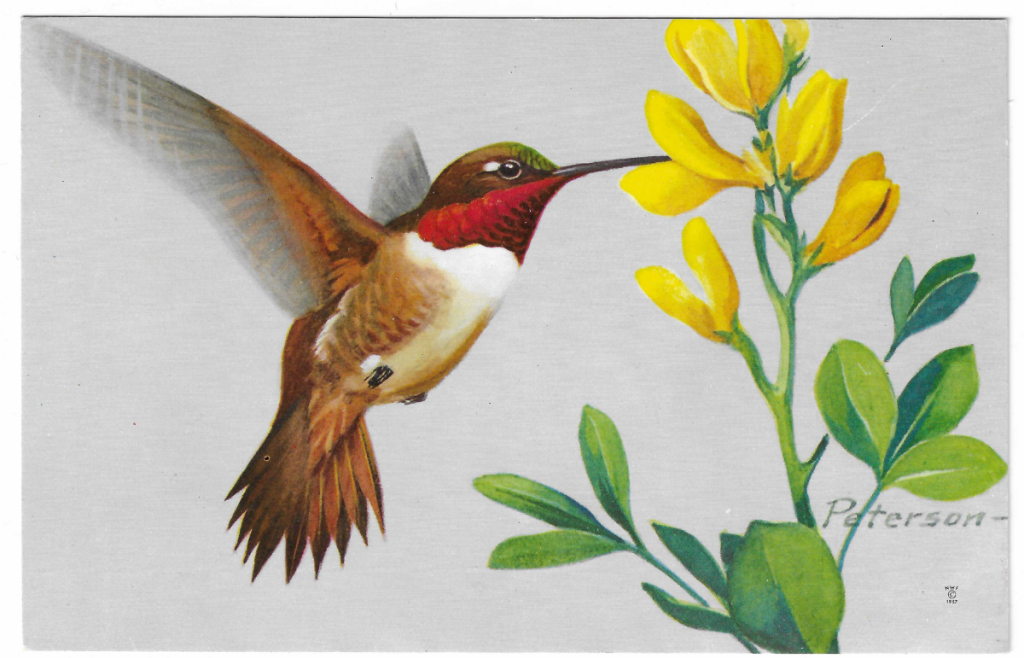
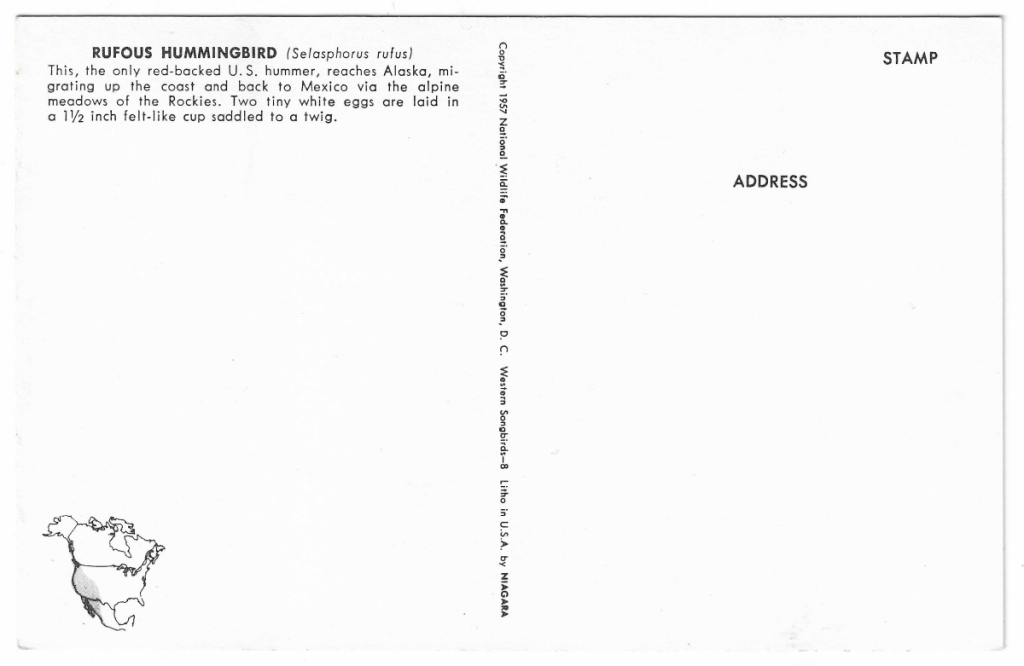
It reads, “This, the only red-backed US hummer. reaches Alaska migrating up the coast and back to Mexico via the alpine meadows of the Rockies. Two tiny white eggs are laid in a one and a half inch felt-like cup saddled to a twig.”
The rufous hummingbird, according to stateofthebirds.org, is on the, quote, “tipping point list,” which are the species that have lost 50% of their populations between 1970 and 2019 and are considered on alert.
The last one I have by Roger Tory Peterson is the Lazuli Bunting, Passerina amoena, Songbird -2, 1959.
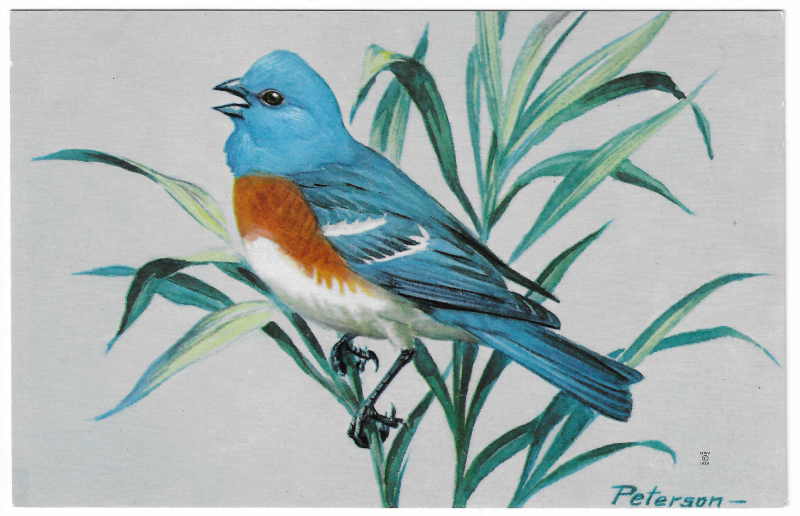
It says, “On slopes of sage and brush, this 5 1/2” bunting sings sweetly with paired notes. Its three to four pale blue eggs are deposited in a cup in a low bush. These birds summer widely in West US and southwest Canada, but enjoy the winters in Mexico.”

It’s named after the gemstone lapis lazuli. The male’s head and part of his wings are a gorgeous bright blue.
We have the Bobcat now, Lynx rufus by Fred Everett, Mammal-4, 1958.
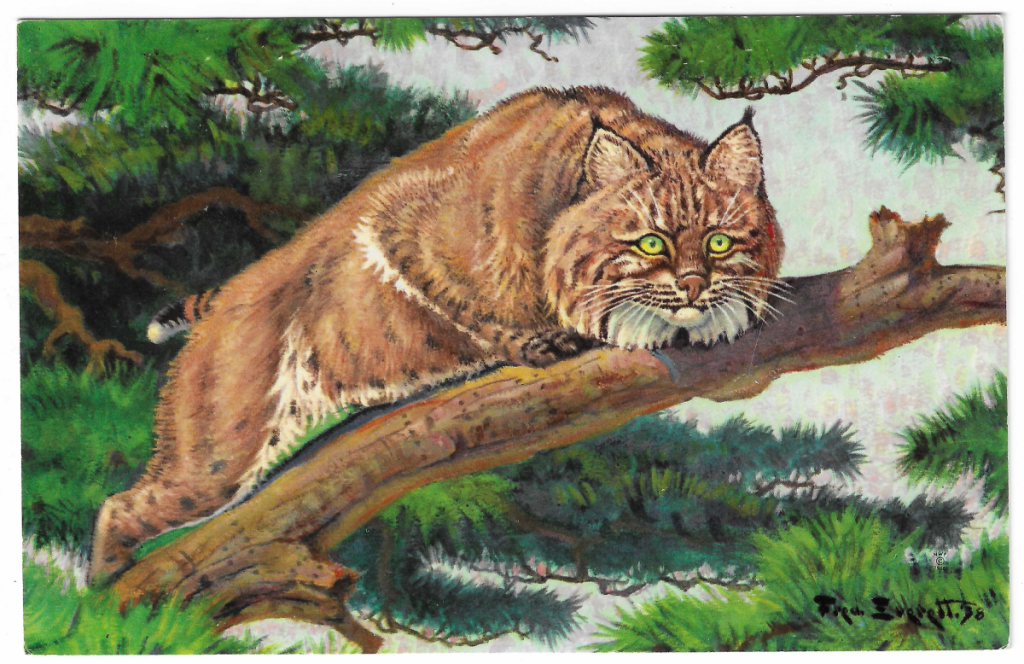
Description says, “Mountain forests in the Northeast, swamps in the south and rimrock in the west are the homes of this long-legged, stub-tailed wildcat. Shy and seldom seen, the bobcat in much of Canada has been replaced by the more powerful tufted lynx.”
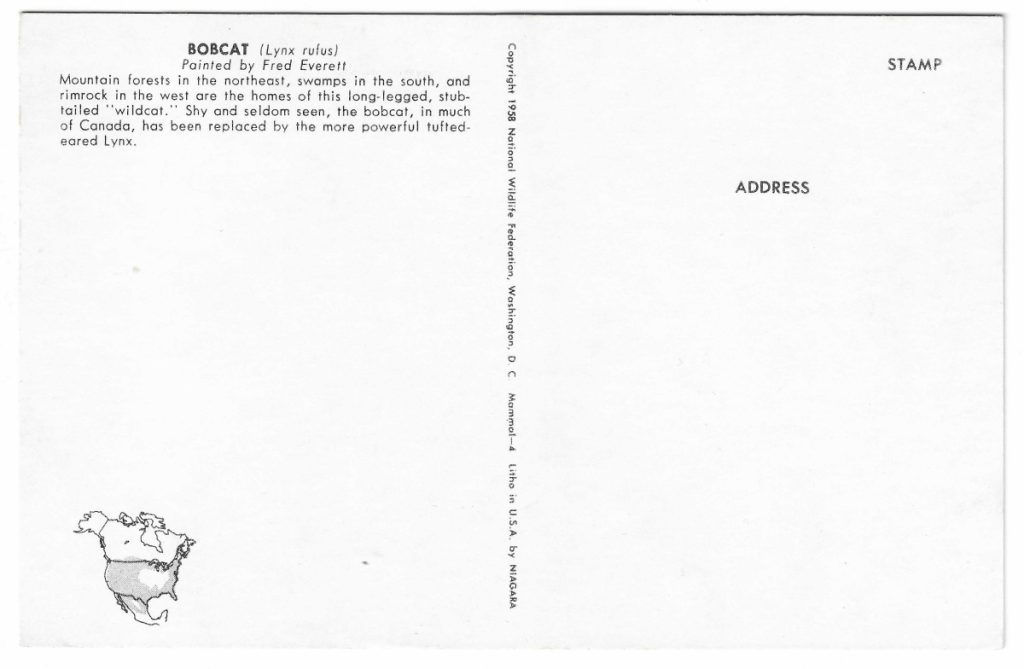
Now, bobcats can jump 10 to 12 feet, they can climb, and they can run upwards of 30 miles per hour.
Fred Everett, the artist, opened an art studio after World War I where he produced pen and ink illustrations for newspaper advertisements, and he also wrote and illustrated three books in the ’40s and ’50s all about wildlife: Wild Ducks in 1946, Fun With Trout in 1952, and Fun With Game Birds in 1954.
Next we have the Bison, and their scientific name is Bison bison, categorized as a mammal-6, 1958, painted by Don R. Eckelberry.
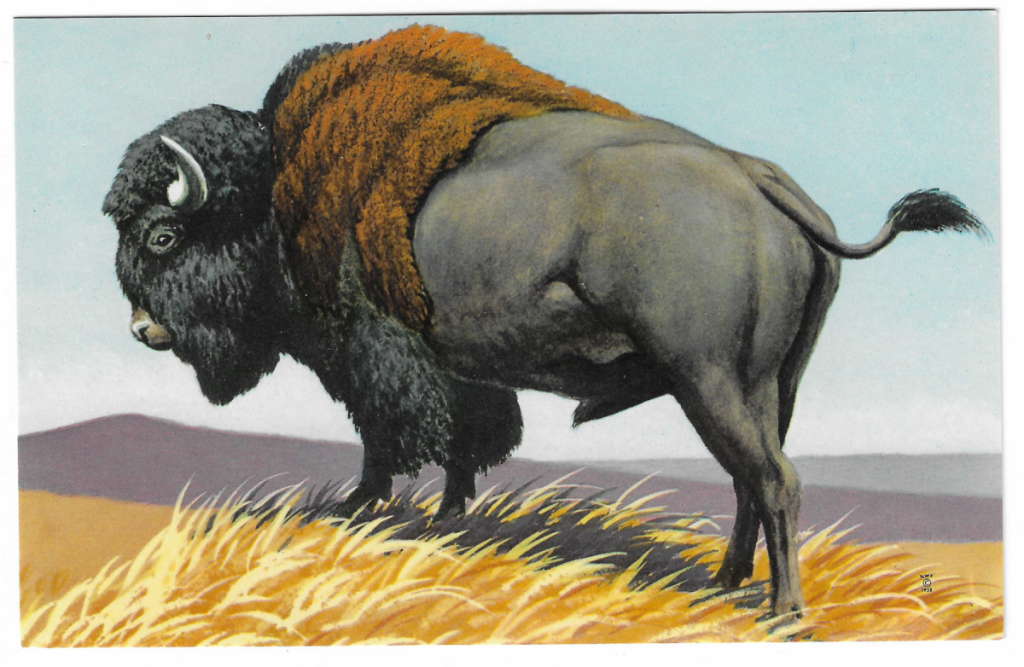
It reads, “Once roaming the American grasslands by tens of millions, the buffalo was so wantingly destroyed that it almost became extinct. As a biological remnant, the species is well-protected now.A few thousands are permitted to live on cattle-free reserves.”
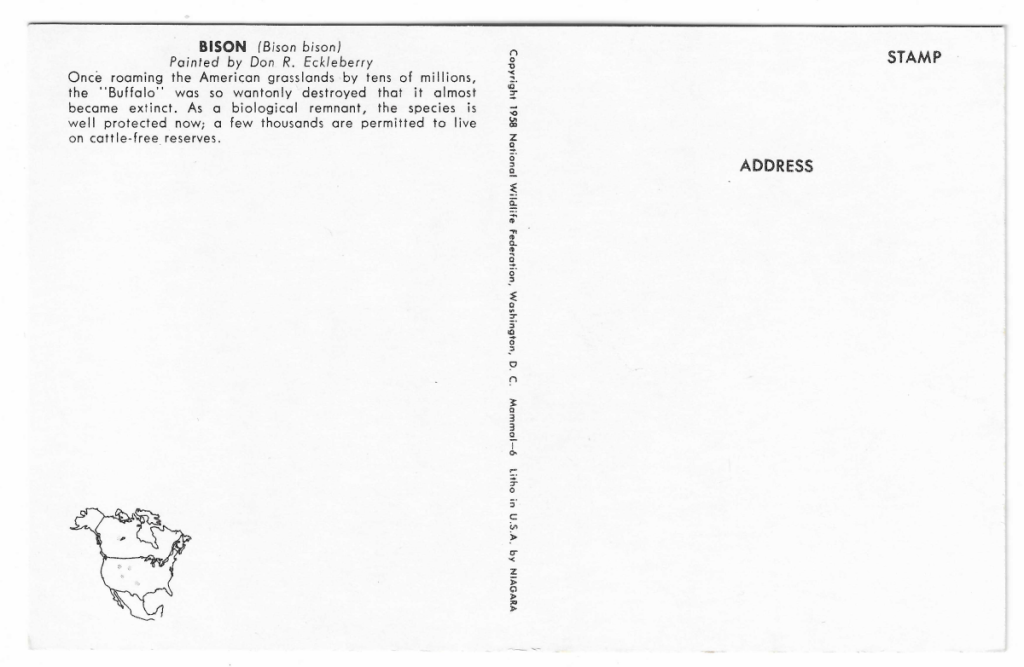
The American bison population was estimated at sixty million in the late eighteenth century, but by 1889, that number had fallen to below six hundred before recovery efforts even began. PBS wrote an article from early 2025 stating that there were forty-five thousand bison across North America at that time.
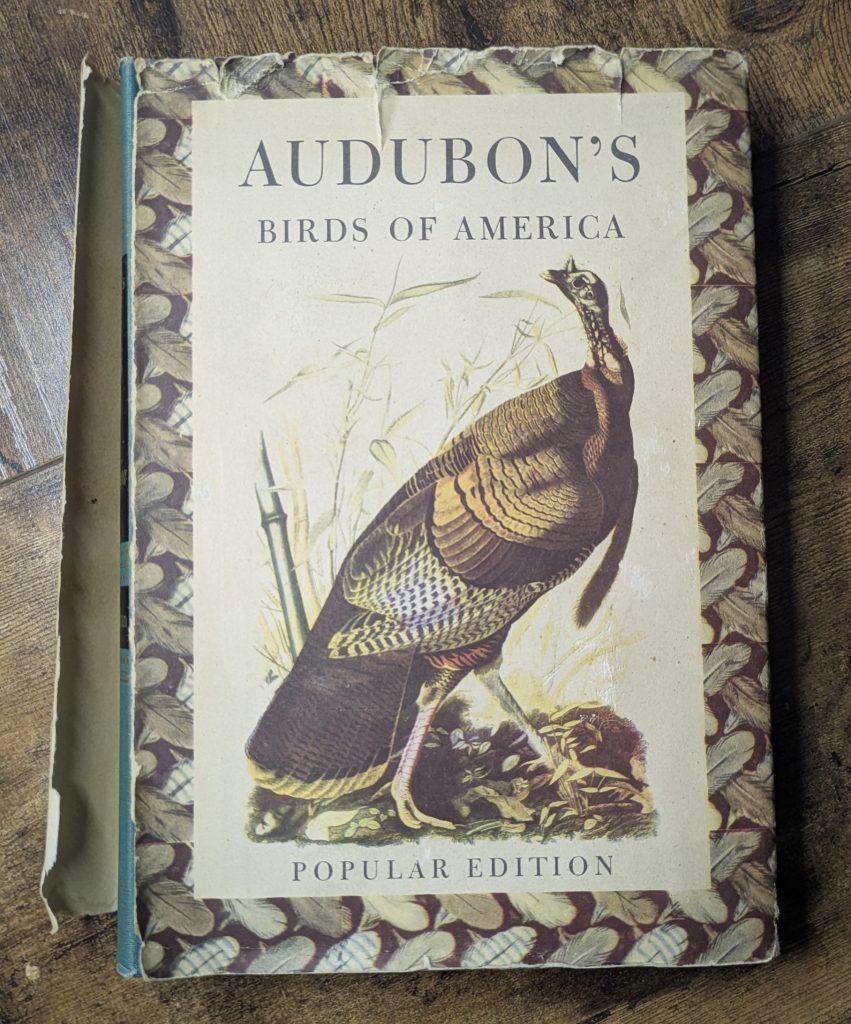
And the artist Don Eckelberry produced one thousand two hundred and fifty images for Audubon bird guides from 1946 to 1957. And another little aside, I’ve had a book forever called Audubon’s Birds of America from 1950. The book jacket is split in half, but it’s beautiful, and the imagery is solely that of John James Audubon, so no Eckelberry.
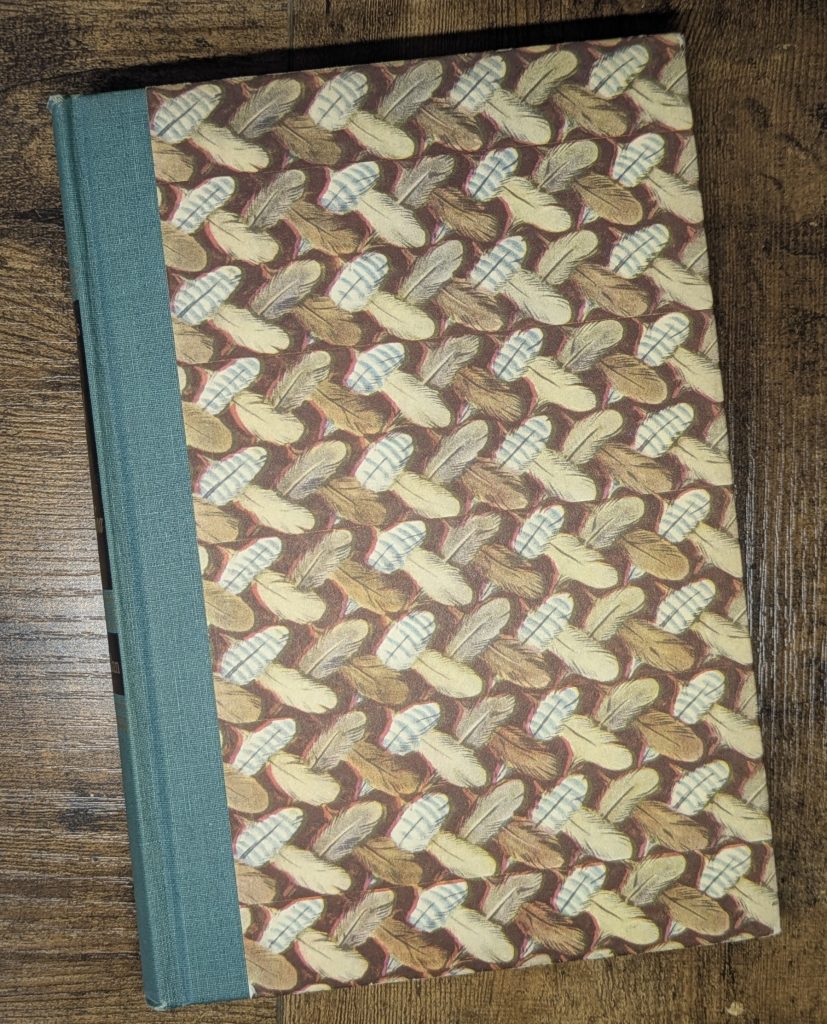
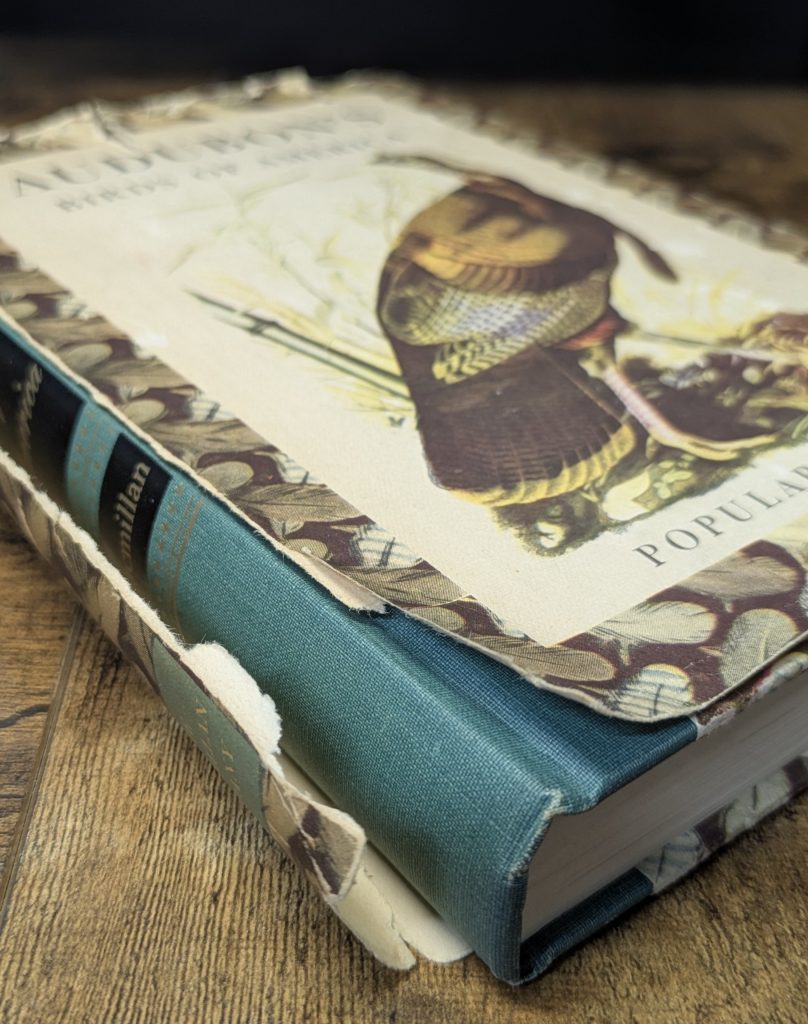
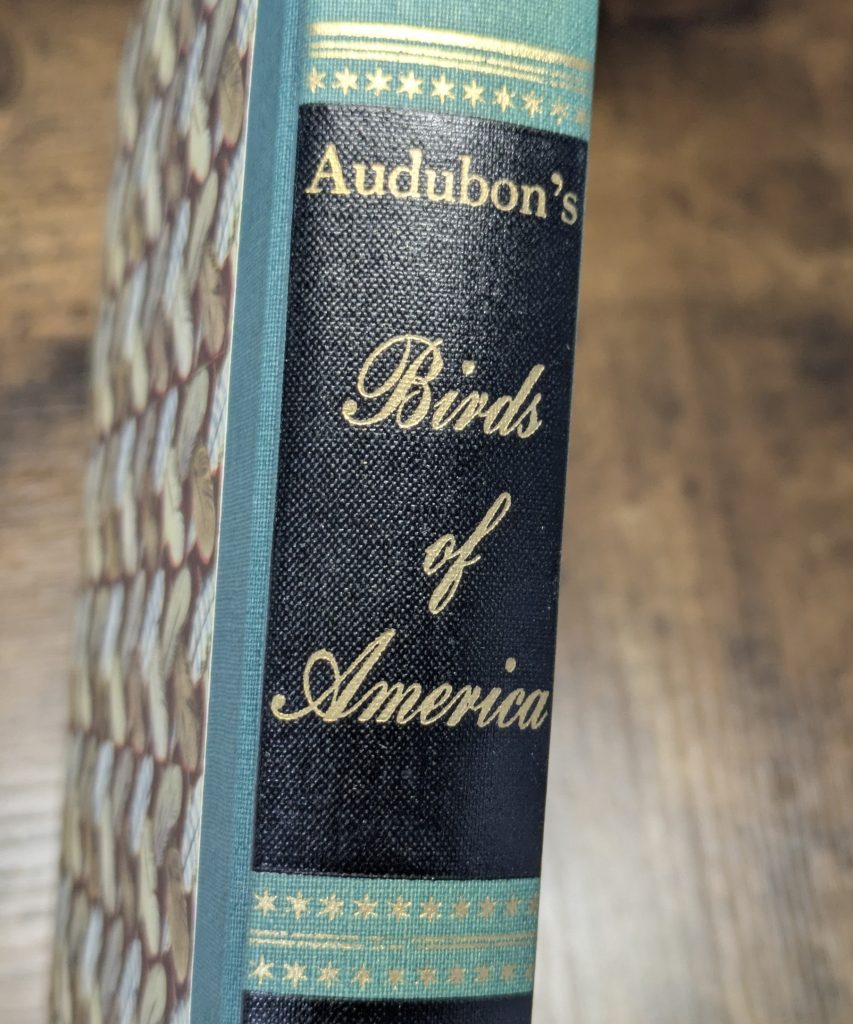
Next, we have the Red Fox, Vulpes fulva, again by Eckelberry, mammal-7, 1958.
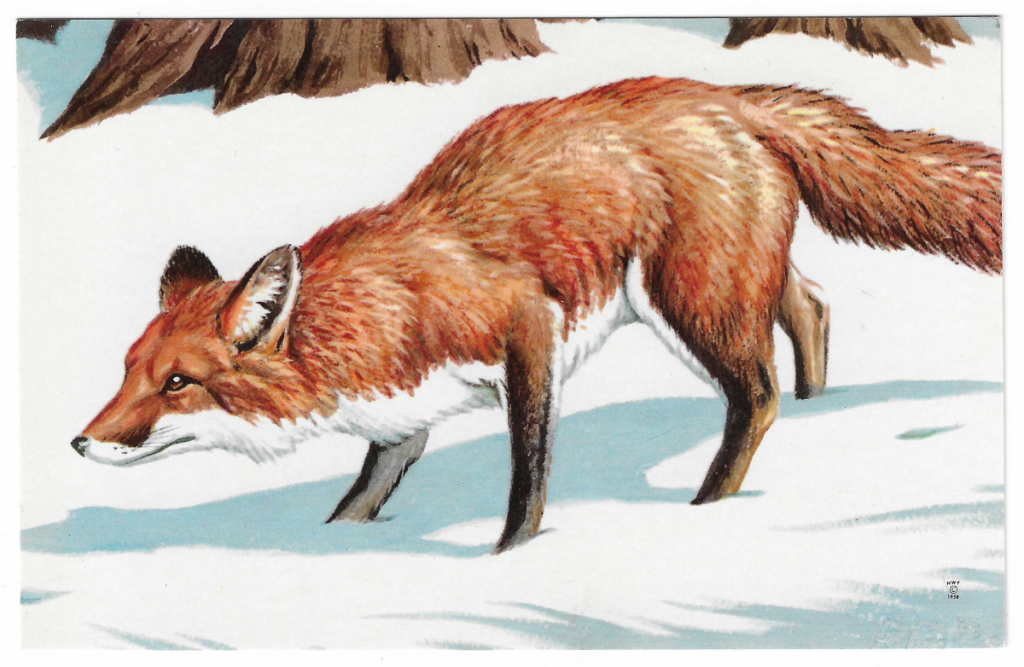
This card says, “This small dog-like animal is sometimes black or silver, but its usual color is reddish yellow with black boots and white-tipped tail. The more southern gray fox has a black tip to its tail.”
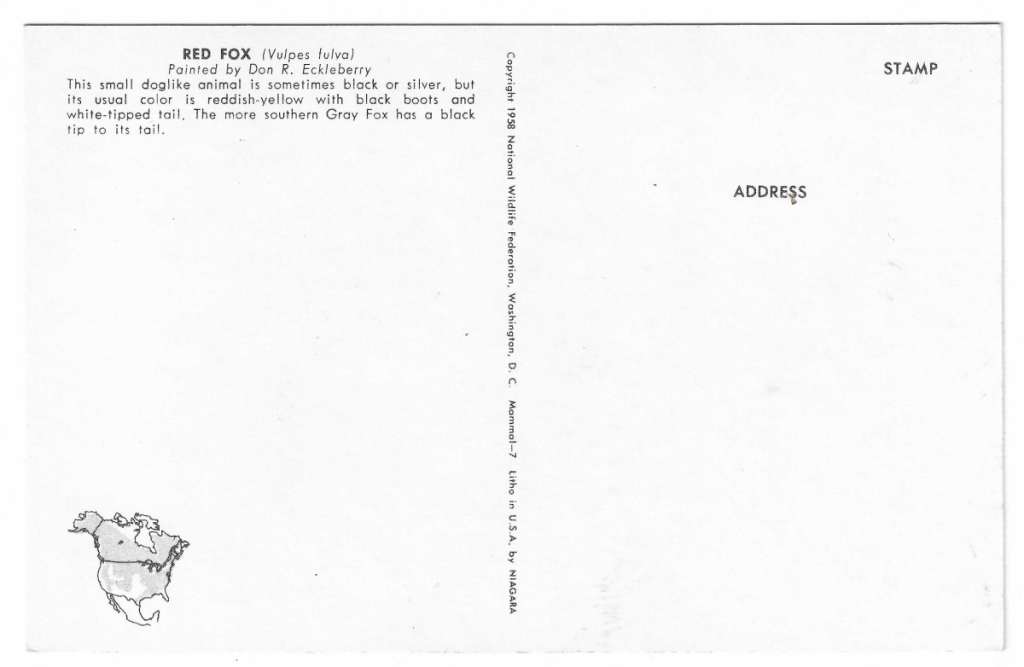
And when looking up the red fox, I found not only Vulpes fulva, but Vulpes vulpes fulva and Vulpes vulpes. The Vulpes vulpes fulva is for the North American subspecies of red fox.
A couple of lines from Wikipedia say, “The North American red foxes have been traditionally considered either as subspecies of the Old World red foxes or subspecies of their own species, Vulpes fulva. Due to the opinion that North American red foxes were introduced from Europe, all North American red foxes have been seen as conspecific with Vulpes vulpes.
However, genetic analysis of global red fox haplotypes indicates that the North American red foxes have been genetically isolated from the Old World populations for four hundred thousand years, prompting possible application of Vulpes fulva to all North American red foxes.”
Not that this is the exact same, but this is when I realized I probably never would’ve made it as a marine biologist.
Thank you for joining me as I shared a snippet of the past. I’d love to know if it connected with you in some way. Did it spark a memory or make you see something differently? If so, consider sharing it. Be sure to check out the show notes for additional info, links, and ways to connect. It’s not nostalgia, it’s human.
Until next time, may you find something worth holding onto
Thank you for coming along with me & if interested, consider signing up for the Newsletter.
DISCLAIMER: The content on this site is for storytelling purposes only.
pinny please