Hey everybody, welcome to Retell Seller, an ephemera podcast where I uncover forgotten stories and the ephemera people leave behind. I’m Angie, a reseller of 10 years, and I’ll share one of those snippets with you. Let’s see what today’s find has to say.
Please know some links in this post are affiliate links. If you click on a link and make a purchase, I may receive a small commission with no extra cost to you. Thank you. Click here for my full disclosure.
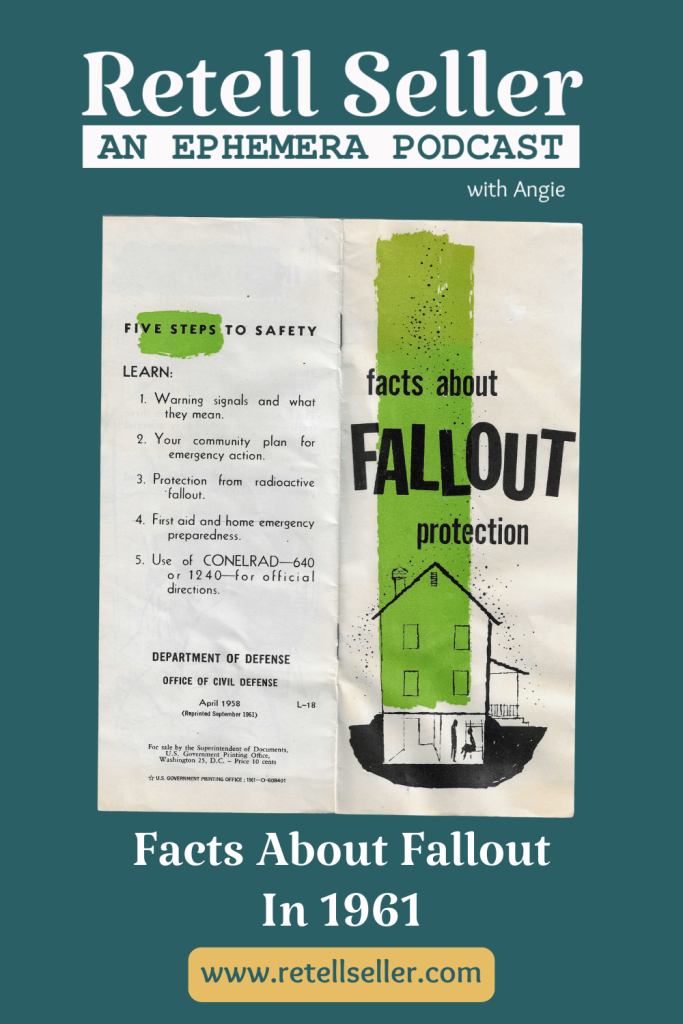
What I’m reading from today is an eight-page pamphlet on fallout protection from 1961. I don’t remember where I got this, but I’m sure it was in a pile of goodies.
The first thing I thought of when I saw this was the movie Blast From The Past. If you haven’t seen it, it’s just a simple movie about a man who believes nuclear war is imminent and prepares an underground bunker for him and his wife and his infant son to ride it out. It ends up being years before their now adult son, Brendan Fraser, decides to venture out into the world to see what’s going on.
And of course there’s the more recent shows like Fallout on Amazon Prime
The pamphlet I have I’m sure used to be white, but it’s now an off-white color. Its wording is black, and each page has an accent green color in various spots.
And if you’d like to see what the pamphlet’s art looks like, be sure to check out the blog at retellseller.com. That’s R-E-T-E-L-L seller.com, or visit the YouTube channel to see the video that goes alongside showing all of what I talk about.
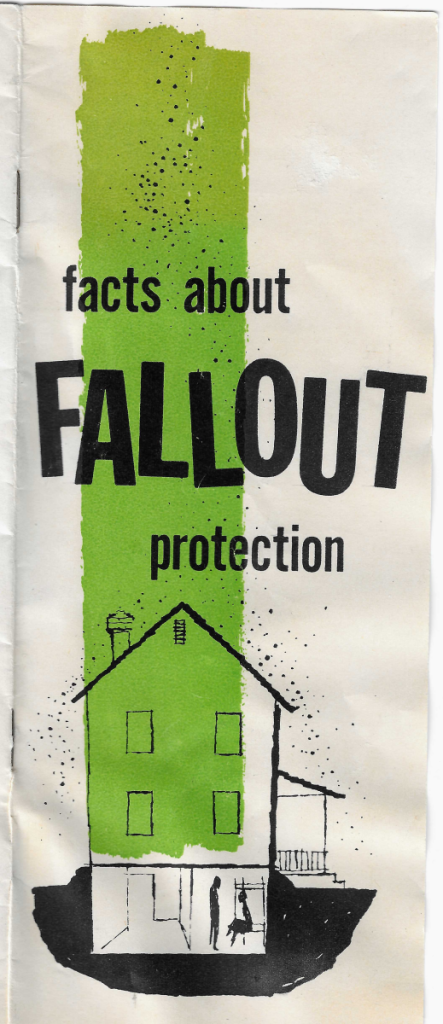
The first page says, facts about FALLOUT protection,
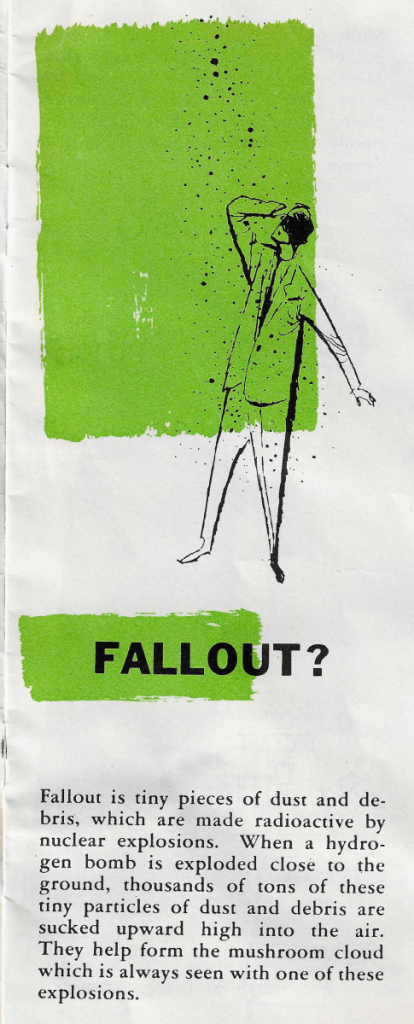
Fallout is tiny pieces of dust and debris which are made radioactive by nuclear explosions. When a hydrogen bomb is exploded close to the ground, thousands of tons of these tiny particles of dust and debris are sucked upward high into the air. They help form the mushroom cloud, which is always seen with one of these explosions.
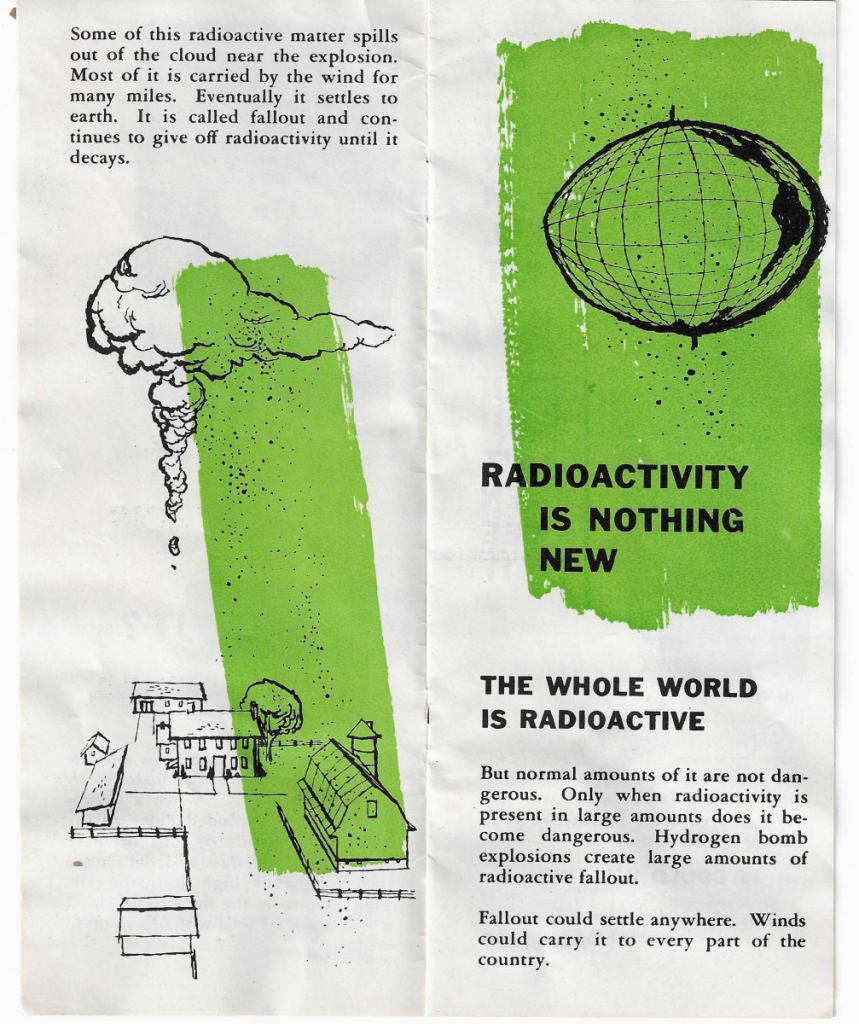
Next page. Some of this radioactive matter spills out of the cloud near the explosion. Most of it is carried by the wind for many miles. Eventually, it settles to Earth. It is called fallout and continues to give off radioactivity until it decays. Radioactivity is nothing new. The whole world is radioactive, but normal amounts of it are not dangerous.
Only when radioactivity is present in large amounts does it become dangerous. Hydrogen bomb explosions create large amounts of radioactive fallout. Fallout could settle anywhere. Winds could carry it to every part of the country.
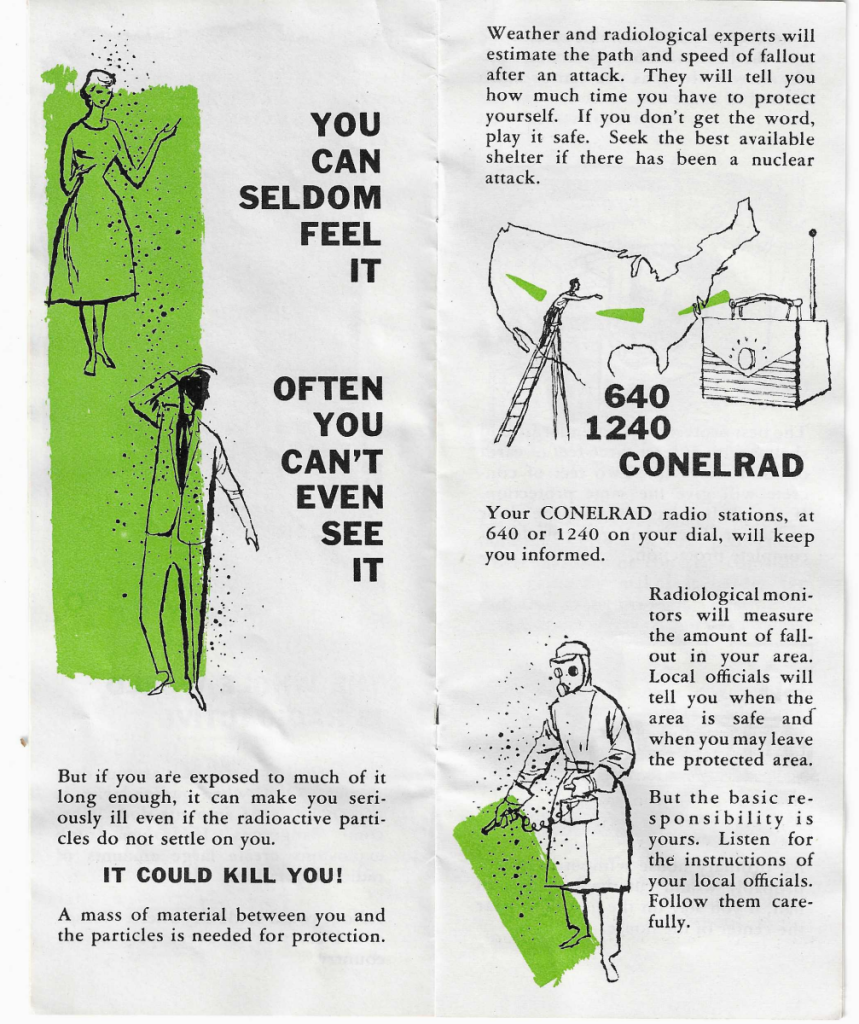
You can seldom feel it. Often you can’t even see it. But if you are exposed to much of it long enough, it can make you seriously ill even if the radioactive particles do not settle on you. It could kill you.
A mass of material between you and the particles is needed for protection. Weather and radiological experts still estimate the path and speed of fallout after an attack. They will tell you how much time you have to protect yourself.
If you don’t get the word, play it safe. Seek the best available shelter if there has been a nuclear attack. Your Conelrad radio stations at six forty or twelve forty on your dial, will keep you informed.
Radiological monitors will measure the amount of fallout in your area. Local officials will tell you when the area is safe and when you may leave the protected area. But the basic responsibility is yours. Listen to your instructions of your local officials. Follow them carefully
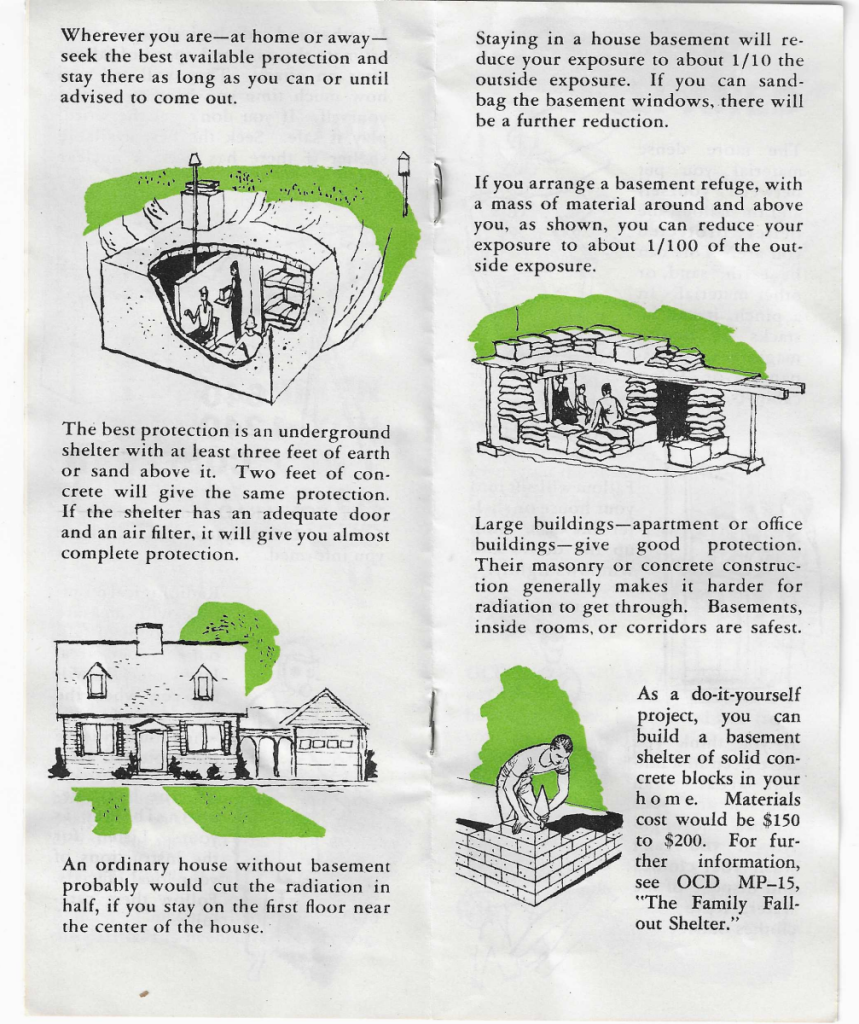
Wherever you are, at home or away, seek the best available protection and stay there as long as you can or until advised to come out. The best protection is an underground shelter with at least three feet of earth or sand above it.
Two feet of concrete will give you the same protection. If the shelter has an adequate door and an air filter, it will give you almost complete protection. An ordinary house without basement probably would cut the radiation in half if you stay on the first floor near the center of the house.
Staying in a house basement will reduce your exposure to about one-tenth the outside exposure. If you can sandbag the basement windows, there will be further reduction. If you arrange a basement refuge with a mass of material around and above you, as shown, you can reduce your exposure to about one one hundredth of the outside exposure.
Large buildings, apartments, or office buildings give good protection. Their masonry or concrete construction generally makes it harder for radiation to get through. Basements, inside rooms, or corridors are safest. As a do-it-yourself project, you can build a basement shelter of solid concrete blocks in your home.
Materials cost would be one hundred and fifty to two hundred dollars. For further information, see OCD MP-15, the Family Fallout Shelter.
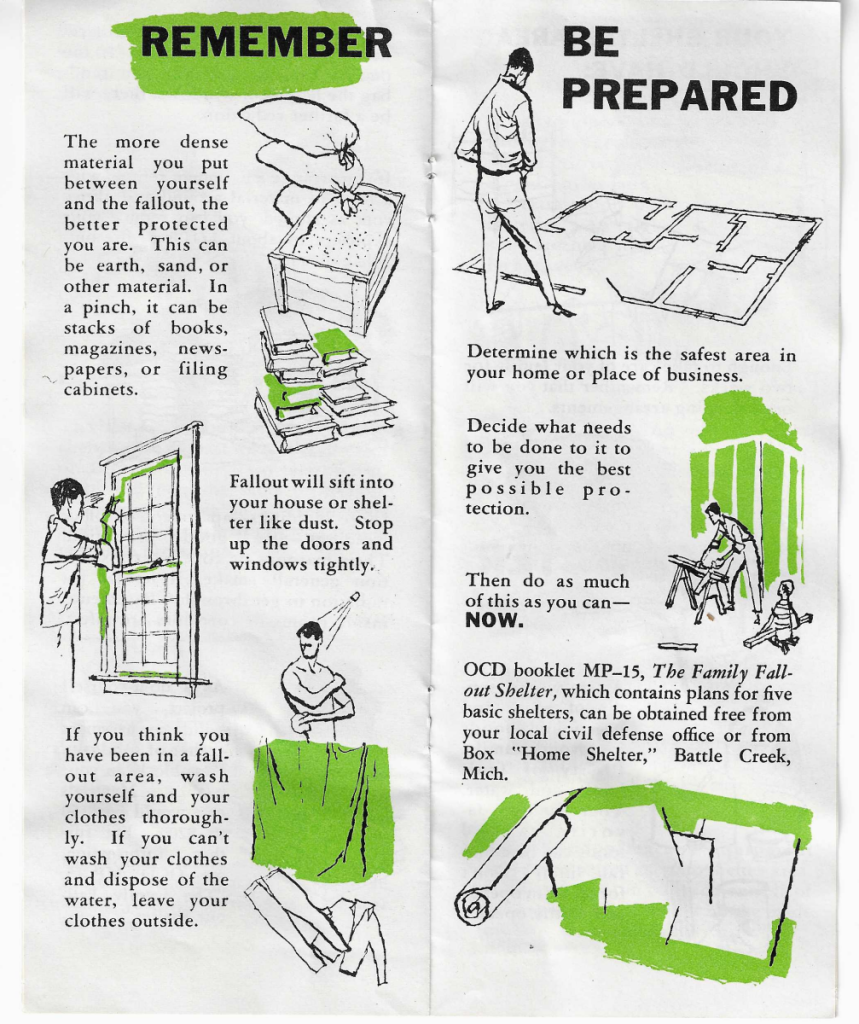
Remember, the more dense material you put between yourself and the fallout, the better protected you are. This can be earth, sand, or other material.
In a pinch, it can be stacks of books, magazines, newspapers, or filing cabinets. Fallout will sift into your house or shelter like dust. Stop up the doors and windows tightly. If you think you have been in a fallout area, wash yourself and your clothes thoroughly. If you can’t wash your clothes and dispose of the water, leave your clothes outside.
Be prepared. Determine which is the safest area in your home or place of business. Decide what needs to be done to it to give you the best possible protection, then do as much of this as you can now.
OCD booklets MP-15, The Family Fallout Shelter, which contains plans for five basic shelters, can be obtained free from your local civil defense office or from Box “Home Shelter” Battle Creek, Michigan.
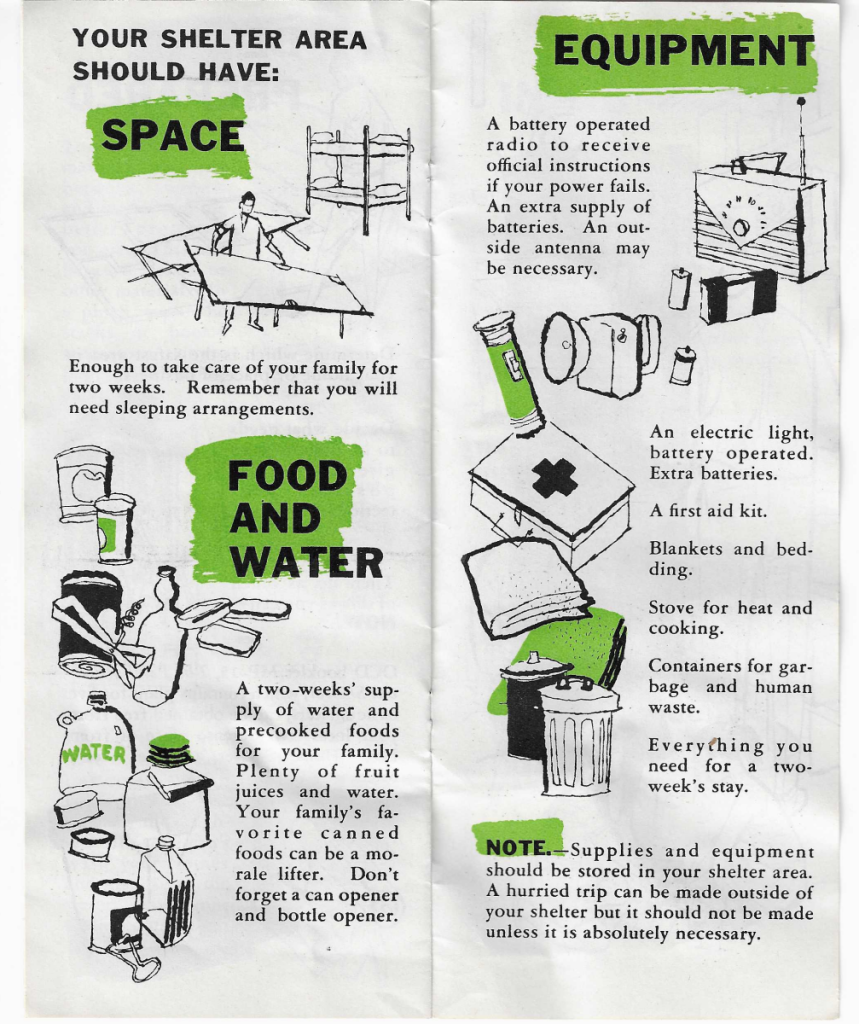
Your shelter area should have space, enough to take care of your family for two weeks. Remember that you will need sleeping arrangements, food and water, a two-week supply of water and pre-cooked foods for your family, plenty of fruit juices and water.
Your family’s favorite canned foods can be a morale lifter. Don’t forget a can opener and a bottle opener. Equipment: a battery-operated radio to receive official instructions if your power fails, an extra supply of batteries. An outside antenna may be necessary. An electric light, battery operated, extra batteries, a first aid kit, blankets and bedding, stove for heat and cooking, containers for garbage and human waste, everything you need for a two-week stay.
Note: Supplies and equipment should be stored in your shelter area. A hurried trip can be made outside of your shelter, But it should not be made unless it is absolutely necessary.
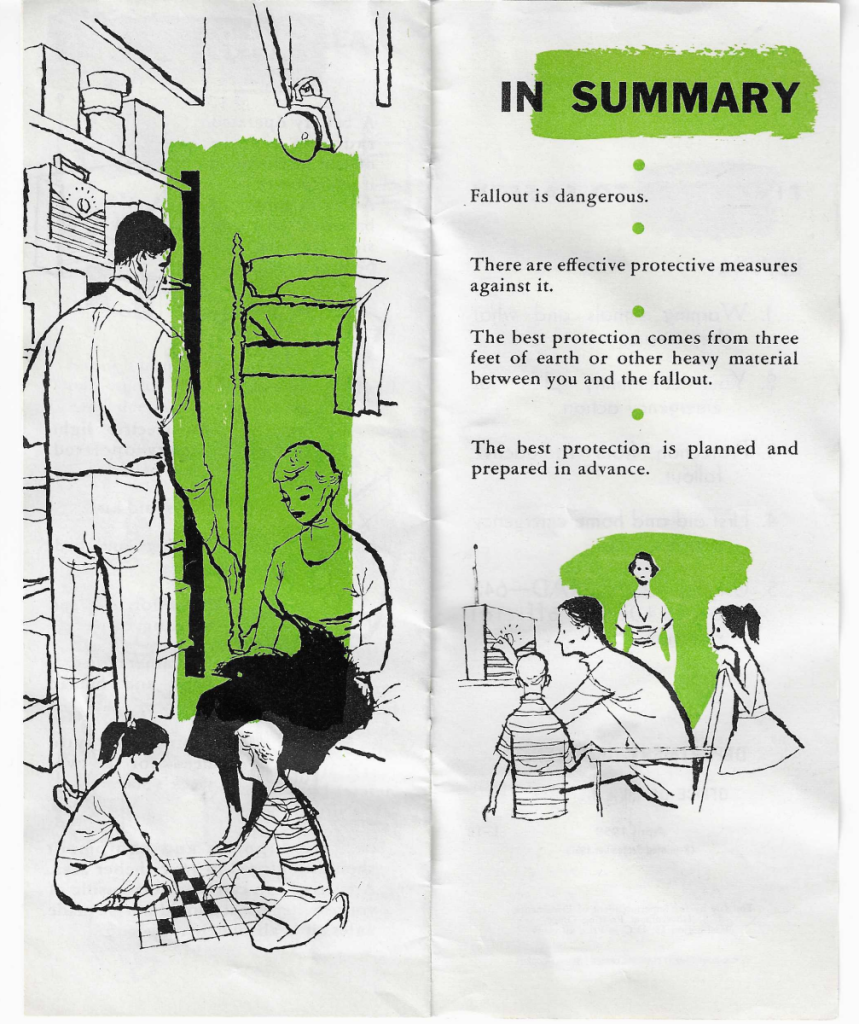
In summary, fallout is dangerous. There are effective protective measures against it. The best protection comes from three feet of earth or other heavy materials between you and the fallout. The best protection is planned and prepared in advance.
Here are five steps to safety.
Learn:
1. Warning signals and what they mean.
2. Your community plan For emergency action.
3. Protection from radioactive fallout.
4. First aid and home emergency preparedness.
5. Use of CONELRAD six forty, or twelve forty for official directions.
Underneath the 5 steps of safety it says,
Department of Defense,
Office of Civil Defense.
April 1958 (reprinted September 1961)
For sale by the Superintendent of Documents,
U.S. Government Printing Office,
Washington 25, D.C. – price 10 cents
When searching Newspapers.com I did find many articles in the late 50s early 60s talking about Fallout with instructions on what do if it were to happen. I also found an image of the exact pamphlet I have which was neat. The newspaper was showing all of the books pertaining to Fallout, home protection, survival plans, even financing your home shelter.
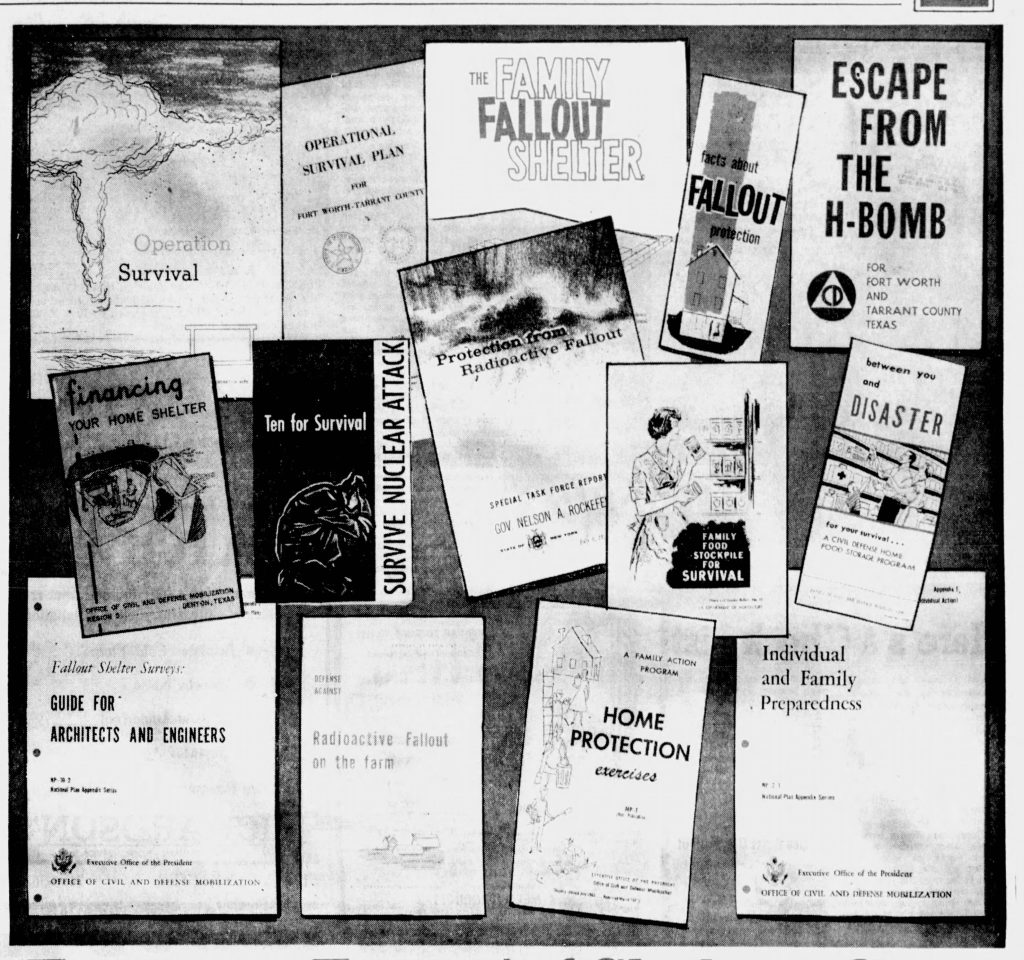
Even though this is from 1961, the thought on being prepared is something I’m definitely on board with. There’s so many more likely things to happen than nuclear war.
It could be an accident of some kind putting you or someone you know in the hospital for a few days. What can be set aside to make a situation like that a little easier at the moment you may be needing to make quick decisions?
And what are the things most likely to happen in your area?
We can’t prepare for every potential disaster or set-back, but what will take the smallest load off of you IF something were to happen?
And prepare for it now.
Thank you for joining me as I shared a snippet of the past. I’d love to know if it connected with you in some way. Did it spark a memory or make you see something differently? If so, consider sharing it. Be sure to check out the show notes for additional info, links, and ways to connect. It’s not nostalgia, it’s human.
Until next time, may you find something worth holding onto
Thank you for coming along with me & if interested, consider signing up for the Newsletter.
DISCLAIMER: The content on this site is for storytelling purposes only.
ADDITIONAL LINKS & INFO:
- Wikipedia – Nuclear Fallout
- CONELRAD systems
- U.S. Environmental Protection Agency
- EPA – Protecting Yourself from Radiation
Twilight Zone episodes about nuclear war:
pinny please