Hey everybody, welcome to Retell Seller, an ephemera podcast where I uncover forgotten stories and the ephemera people leave behind. I’m Angie, a reseller of 10 years, and I’ll share one of those snippets with you. Let’s see what today’s find has to say
Please know some links in this post are affiliate links. If you click on a link and make a purchase, I may receive a small commission with no extra cost to you. Thank you. Click here for my full disclosure.
Today I am looking at a postcard. The top of the card’s front says, “Team of Ostriches, South Pasadena, California.”
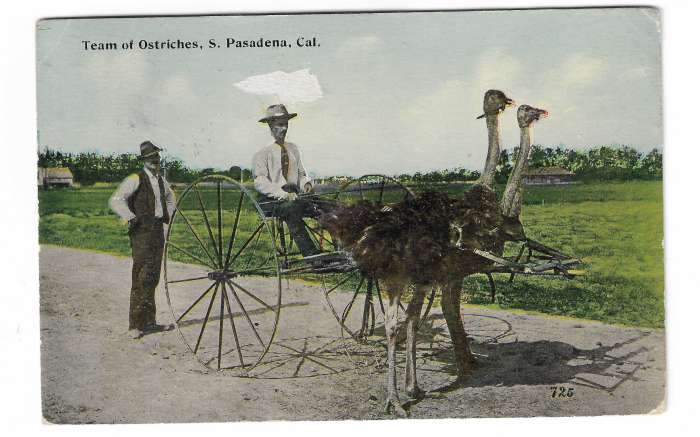
The imagery is of a man standing with his hands on his hips. He’s wearing a dress shirt, dress pants with a vest, wearing a hat. Right in front of him, there’s a man sitting on a buggy, holding a whip, being pulled by two ostriches. They’re in the middle of the road with grassland off to the side in the distance, along with a few houses.
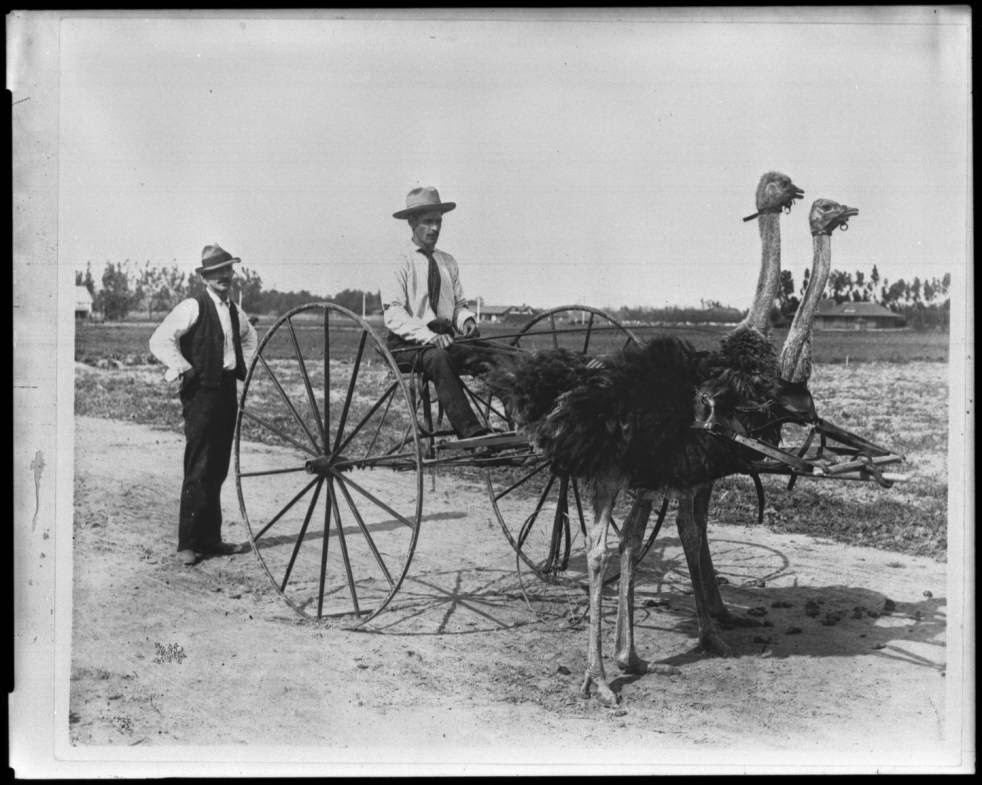
I found the original black and white photo this card was created from, and this one is just a colorized version. It’s in rough shape with a thin layer ripped off right above the man on the cart. It has rough edges and staining throughout.
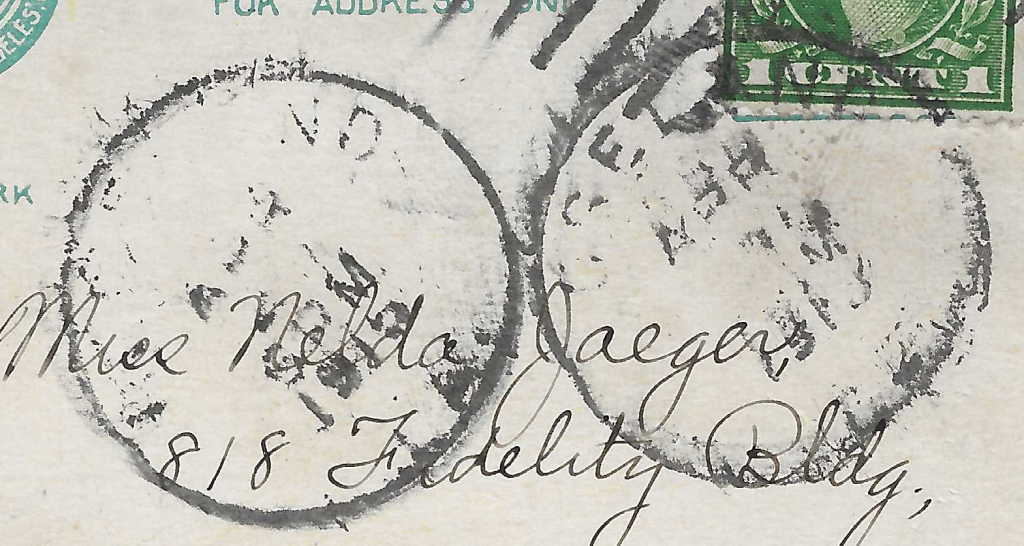
It’s stamped twice, and both are pretty difficult to read, but luckily, the sender did write at the top, “Roseland, Louisiana, April 29, 1915.”

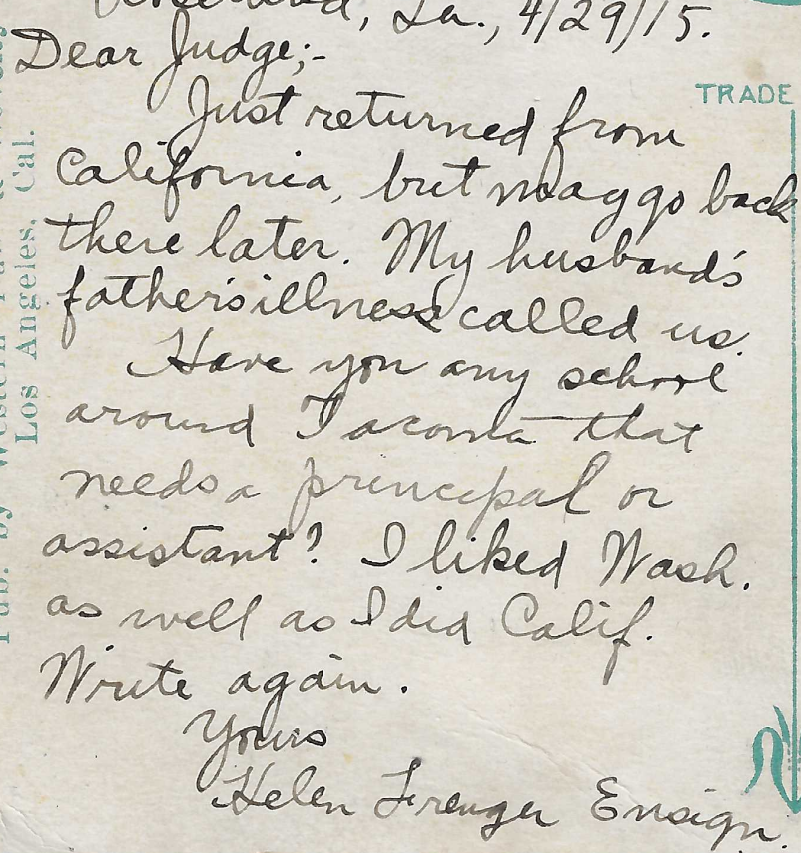
The message starts off,
“Dear Judge, Just returned from California, but may go back there later. My husband’s father’s illness called us. Have you any school around Tacoma that needs a principal or assistant? I like Washington as well as I did California. Write again. Yours, Helen”
I was curious as to why Helen referred to the recipient, Nelda Jaeger, as Judge, and to my surprise, Nelda Jaeger was indeed a judge in Tacoma, Washington, in 1915.
I’ll go through some various articles I found on her, starting off, as a young person in 1895, she was in the paper for having recited “The Arrow and the Song” by Henry Wadsworth Longfellow during the graduation ceremony for the older kids from eighth grade.

Free Trial
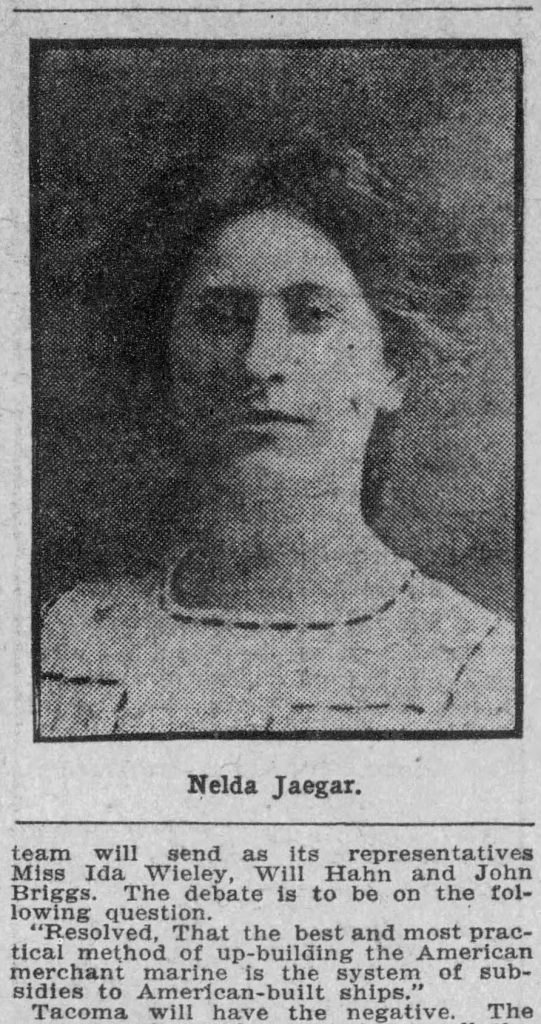
In 1906, while in high school, she was on the girls’ debate team, and one of the debates she took part in was called “Resolved: That the best and most advantageous method for building up the merchant marine is the system of subsidies to American-built ships,” and she would be arguing against this.
In March of 1911, Nelda was interviewed and the article was titled, “Woman Lawyer Tells How She Entered the Profession.”
And I thought it was a really interesting article. I’ll read some parts of it now.
“Nelda Jaeger is the youngest of the three women now actively engaged in the practice of law in Tacoma. She graduated in June of 1910 from the University of Washington, the only woman in a class of fifty men.
Miss Jeager’s case might be taken as an example of the way most women enter into a professional life. They get into it by degrees, just as Miss Jeager did.
I decided to take a few lectures in the law department. These lectures were the little taste that led to a habit. I cut down my other studies and devoted more time to the law lectures until at the end of the first semester, I hardly went near the other departments.
I was so absorbed in my newfound work that I really did not realize the way I had unconsciously chosen for myself. Until one day, I woke up to the necessity of eliminating one branch or the other if I was to make progress in anything. I eliminated the liberal arts and grappled with the intricacies of the law.
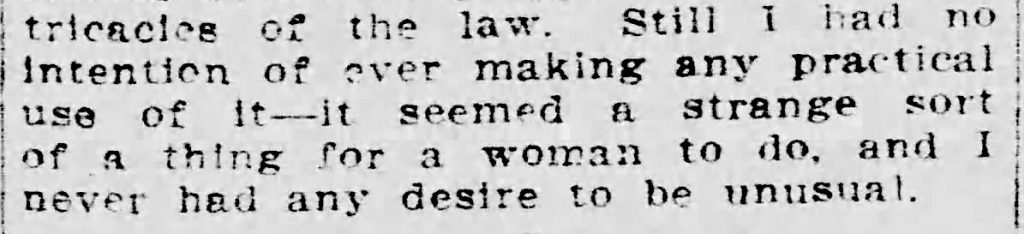
Still, I had no intention of ever making any practical use of it. It seemed a strange sort of thing for a woman to do, and I never had any desire to be unusual. The day after my graduation, I drew up my first legal document and received my first fee.
Free Trial
One of my girlfriends wanted to sell a piece of property, and she asked me to draw up the contract. I was terribly frightened at the responsibility, but I took a chance, and the contract proved all right.
Then one day, an opportunity presented itself to do some of the work in a downtown law firm. You see, I was going by easy states. I shoved my prejudices far enough back in my consciousness to allow me to take this next step.
I believe that nothing but prejudice keeps more women from studying and practicing law. It seems to me that women could argue before a jury fully as convincingly as lots of men I have heard. And when it comes to a woman being tried on a criminal case, I feel that a woman would perhaps be better able to understand her than a man would.
You know there is considerable agitation about having women on the jury when a woman is tried for her life.”
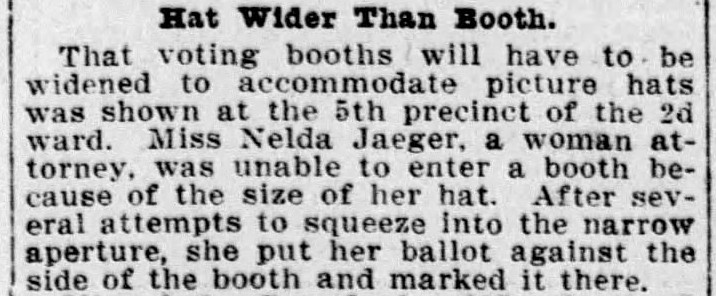
There was another story about Nelda regarding voting, but it was about her hat.
Free Trial
It says, “Miss Nelda Jaeger, a woman attorney, was unable to enter a booth because of the size of her hat. After several attempts to squeeze into the narrow aperture, she put her ballot against the side of the booth and marked it there.”
Free Trial
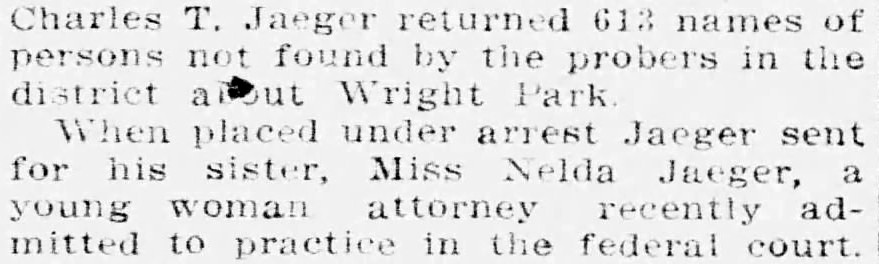
In 1911, At the request of her brother Charles, Nelda took on his case where he, along with multiple others, were being indicted for fraudulently adding names to census information. He came back with 613 names not found when looked into further.
Free Trial
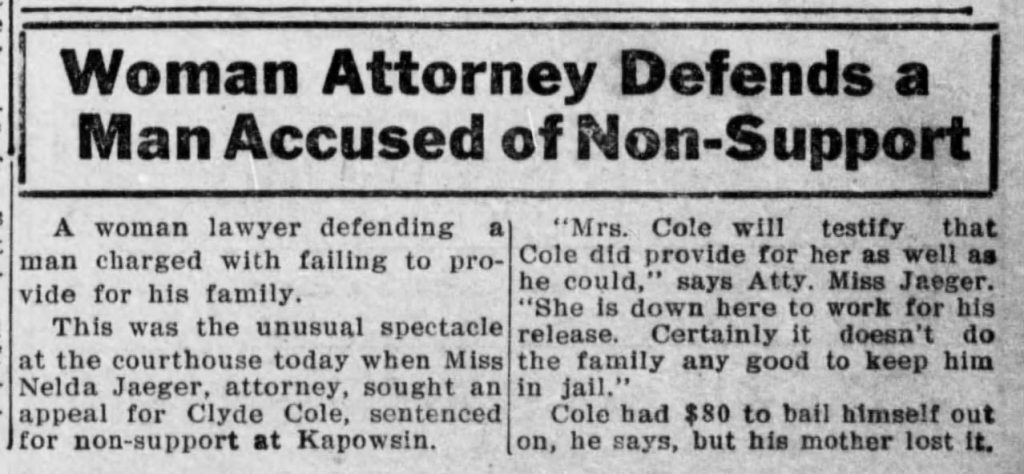
In October of 1911, Nelda worked a criminal case where she represented Clyde Cole. He was being accused of failing to provide for his family.
Free Trial
Nelda had stated Clyde’s wife would testify, saying Cole did provide as best he could, and Nelda stated, “Certainly it doesn’t do the family any good to keep him in jail.” Cole did have the $80 to bail himself out, But his mother apparently lost it. The $80 would be about twenty-eight hundred dollars today.
In October of 1912, Nelda was appointed to represent Tom O’Malley, who had allegedly robbed a bank while under the influence of cocaine. Her address to the jury told of how before the robbery, Tom, knowing he had a drug problem and not wanting it to become worse, went to the jail and asked that he be locked up so that he couldn’t get any drugs.
Tom sat in jail for about two months, and by then he was weak, broken down, and suffering from withdrawals. He had the thought of trying to get a job outdoors, so he went to go buy a pair of work shoes, all while sick and not really having eaten anything, when he saw someone he knew who offered him a drink, which led to cocaine.
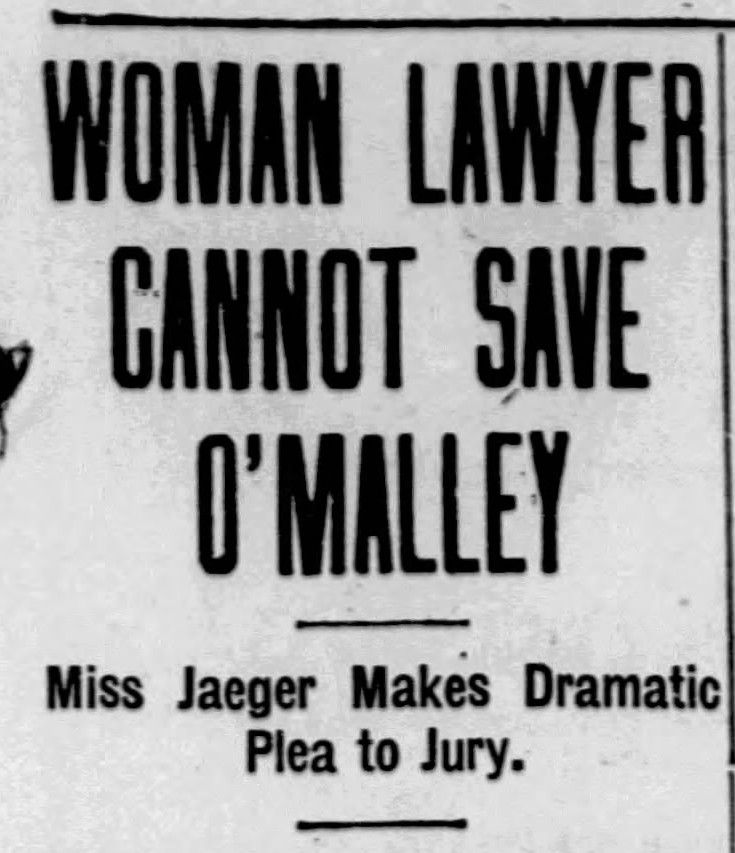
They did find him guilty, even though Nelda stated, quote, “There is not a particle of testimony to prove a wrongful intent. And without this, you must declare the defendant not guilty, for wrongful intent is a necessary element of the crime charged, and the burden of proving it rests with the state. But all of the evidence in this case shows that the defendant not only did not have a wrongful intent, but was insane at the time, and so could not have an intent of any kind, and could not know right from wrong.
How the prosecutor can come here and deliberately ask you to brand this boy for life with a stigma and a conviction for felony is more than I can understand. Ye gods, Nolte, why don’t you prosecute criminals instead of persecuting boys? Is it that for a mere matter of personal glory you would recklessly spend the county’s money, break a mother’s heart, keep a poor lad in jail for five months just because in his sublime courage to rid himself of the use of cocaine, he refrained from it so long that he is physically and mentally weakened and his power of resistance broken down so that in an unguarded moment, his old enemy made him insane?
Would you attempt to wreck that young boy’s whole future life?”
Following that, 1913 saw Nelda get a high court license and was admitted to the Supreme Court Bar. It was also in the papers, just like a couple of my previous episodes, where practically everything was shared, and this one stated, “Miss Nelda Jaeger returned Wednesday from an extended trip through the East, visiting in New York, Boston, and other eastern cities.”

Free Trial
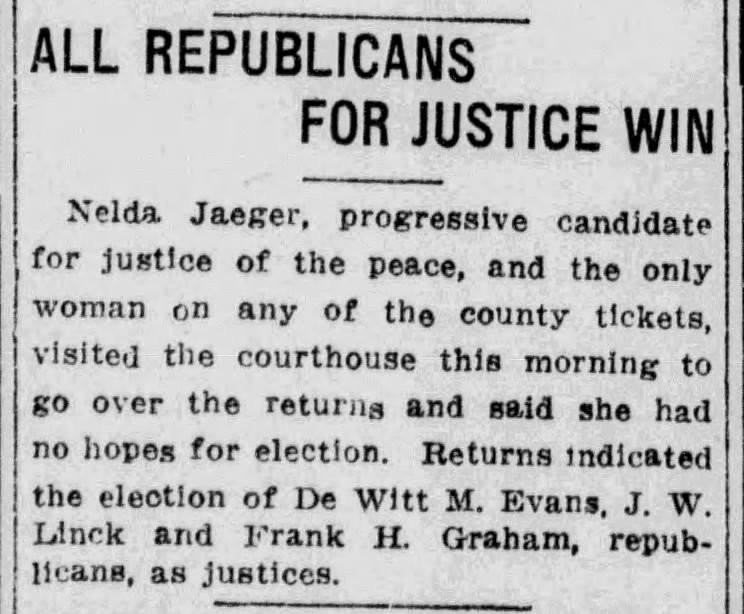
In 1914, she ran as a progressive candidate for Justice of the Peace. An article posted saying that Nelda said she had no hopes for election, and she did not win, and instead four Republican men won.
Free Trial
That same year, Judge Frank Magill contacted Nelda to see if she could temporarily fill in for him, and she accepted.
And when interviewed about it, she said, “It was difficult for me to harden my heart to pass sentence on prisoners. It was necessary that I carry out the law, however, and to place my tender feelings beneath the desk. Although it was a bit unusual, I experienced no nervousness or what may be termed stage fright.”
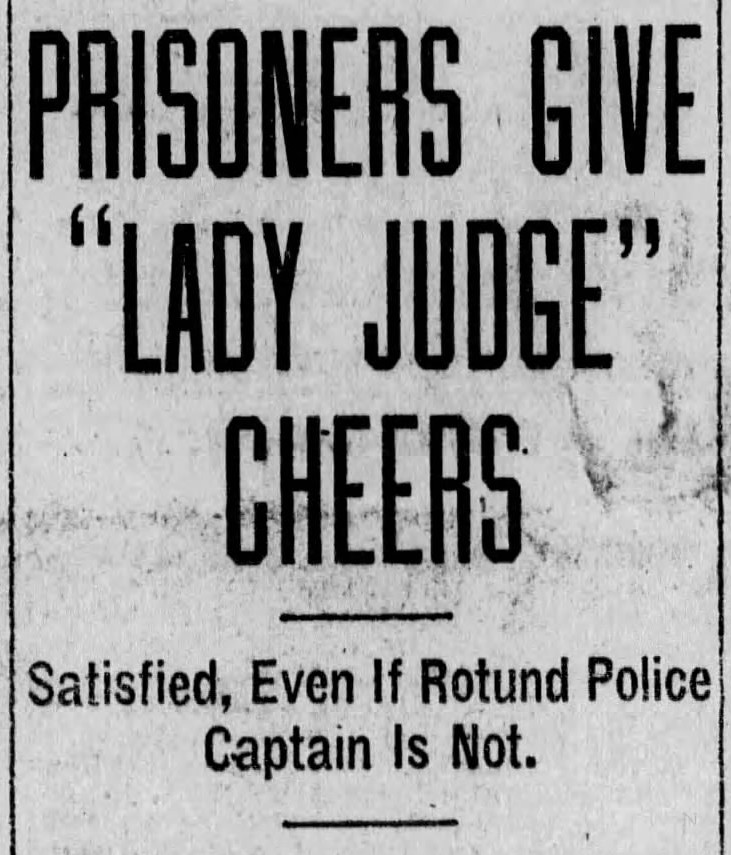
The paper definitely jumped on the chance to write up an article about the cases she worked with that one day as temporary police judge. The title reads, “Prisoners Give Lady Judge Cheers: Satisfied Even If Rotund Police Captain Is Not.”
Free Trial
It starts off announcing Nelda was the temporary judge filling in for Magill, and how the prisoners were not notified of the change.
It says, “They were a little taken aback when they marched into court, for many a familiar police court figure ranged itself in the front row with no sign of hope. But they spied a new judge.” Could it be true? Hope rose within every breast and gleamed in every eye, despite the influence of the baleful, somewhat apprehensive eye of Police Captain Reed, court bailiff, as he glared upon them.
So the first guy comes up and pleads guilty, and Judge Jaeger requested that Officer Strickland, one of the officers having picked him up, to give testimony to which rotund Captain Reed says,
“Madam, Your Honor, the evidence of the officer is not taken where they plead guilty.”
“But I desire it,” said Miss Jaeger.
“Miss, Your Honor,” said Officer Strickland. “He lies continually in the gutter. He is a notorious drunk.”
“Poor man,” the judge murmured. “Will you promise me to leave town if I let you go, my good man?”
“Sure,” said Coughlin. “I’ll never come into this court again.”
“Nor any other court?” asked the fair Portia.
“No, ma’am,” said the dutiful Coughlin.
“Then you may go,” said Miss Jaeger
In the end, she saw 16 cases that day. The paper said, quote, “It was a great strain on their ideas of justice. But when the prisoners arrived in their cells in the jail below, three rahs and a tiger, or something that sounded that way, were given for the lady judge.”
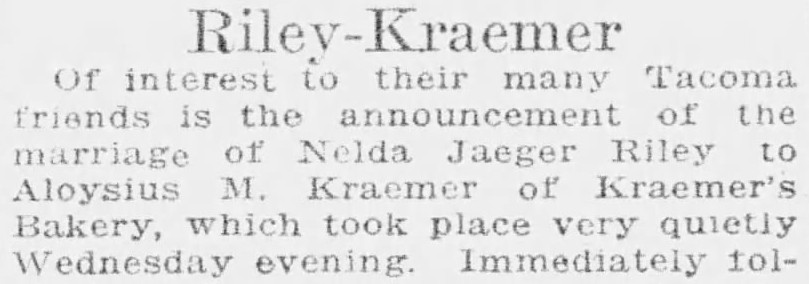
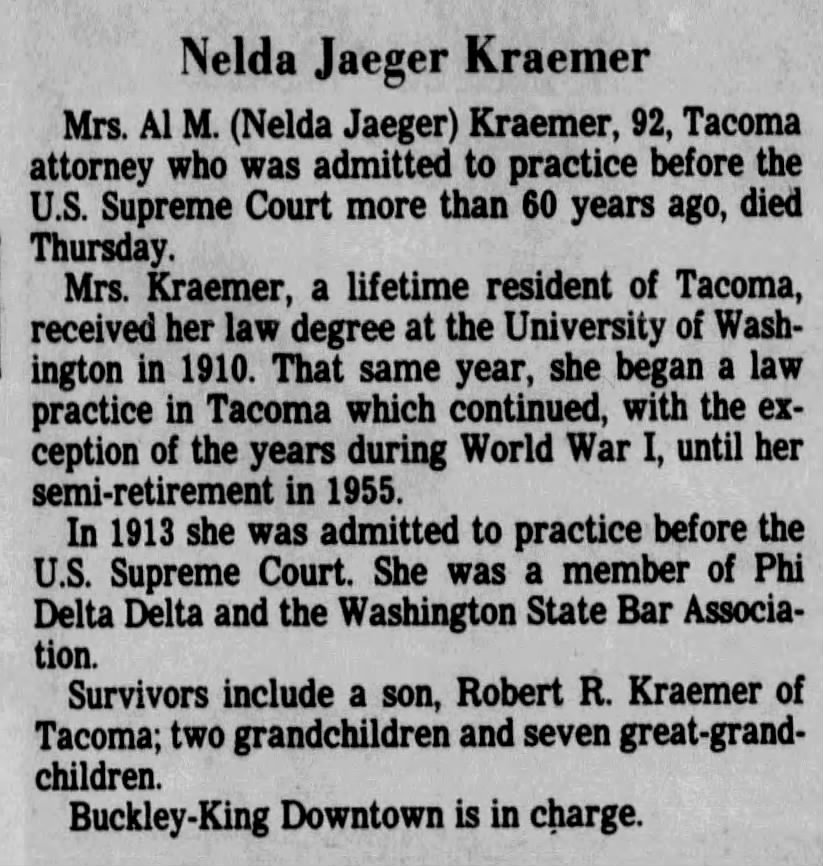
Nelda had been married three times, twice to Frank Riley, also an attorney and in 1920, she married again to Aloysius Kraemer, who owned Kraemer’s Bakery.
Free Trial
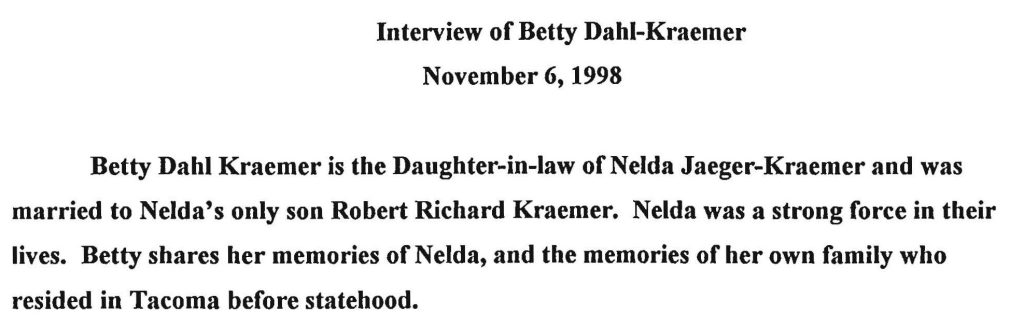
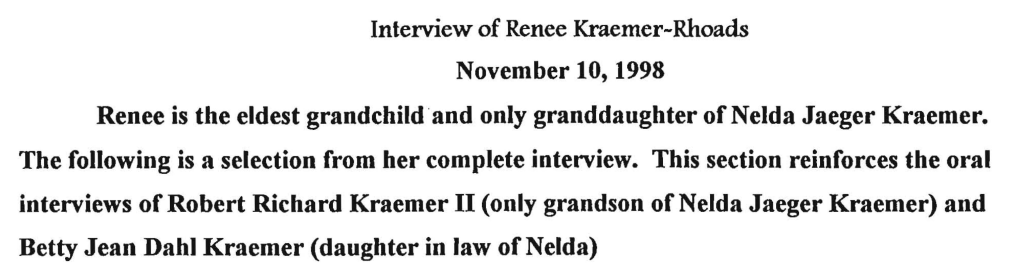
I found three interviews from 1998 where Nelda’s daughter-in-law, Betty, and two of her grandchildren were interviewed.
Betty said that Nelda never liked her and would put her down whenever possible. She said she was bullheaded, quiet, but forceful. She spoke of how Nelda had to fight to be the person she became.
Her father was extremely strict and would eat dinner with a riding crop at the table, and if the kids spoke when not spoken to, they were swatted. If they spoke English instead of German, they were swatted.
She also said Nelda was a witch on wheels, but when I wanna put her down, I can’t. I cannot have anything but admiration for her.
Robert Kraemer Jr., Betty’s son and Nelda’s grandson, said he thought Nelda went to law school to make her father happy. He believed she was a feminist in a conservative way. Nelda was apparently a very talented painter, and Robert remembers asking her why she didn’t become an artist, and she replied with, “Because it has no social value.”
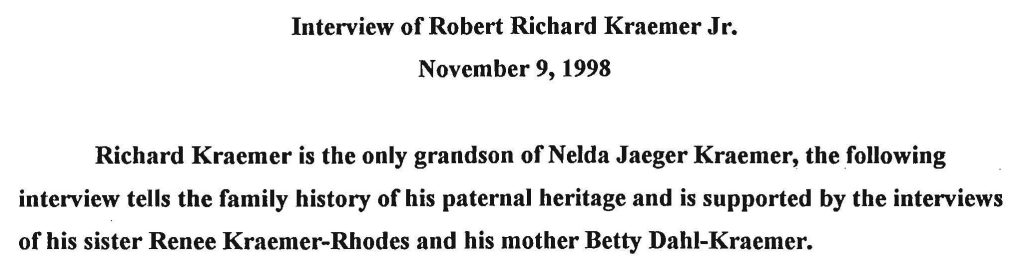
Later, he tells a story of how his Grandpa Kraemer and Nelda had separated, saying he was sure his grandmother, quote, “Tried to get all the tangible things she could and financial interest she could get from him.”
Kraemer had been married twice before Nelda, with both women having died of illnesses, and apparently told Robert Kraemer Sr., and Robert’s wife, Betty, quote, “I have outlived two beautiful women, then I had to marry a bitch.”
The eldest grandchild and sister to Robert Jr. is Renee. One part Renee says, “Grandma was a real special lady in our lives. Certainly was. I have a lot of very fond memories of the things we did together, but I know that she was always, always in my mind, was always a very, very smart lady, very, very bright, yet sometimes unhappy. I do not remember her being extremely happy when I grew up.”
Nelda continued to practice law up until she was about sixty-eight years old in 1955, and she died November 15th, 1979.
Free Trial
The interviews I found of Nelda’s relatives offer so much more than what the newspaper shared in the teens, ‘ 20s, ’30s. So I’ll share that link, as they’re freely available through the University of Washington’s digital collections.
Thank you for joining me as I shared a snippet of the past. I’d love to know if it connected with you in some way. Did it spark a memory or make you see something differently? If so, consider sharing it. Be sure to check out the show notes for additional info, links, and ways to connect. It’s not nostalgia, it’s human.
Until next time, may you find something worth holding onto
Thank you for coming along with me & if interested, consider signing up for the Newsletter.
DISCLAIMER: The content on this site is for storytelling purposes only.
pinny please